
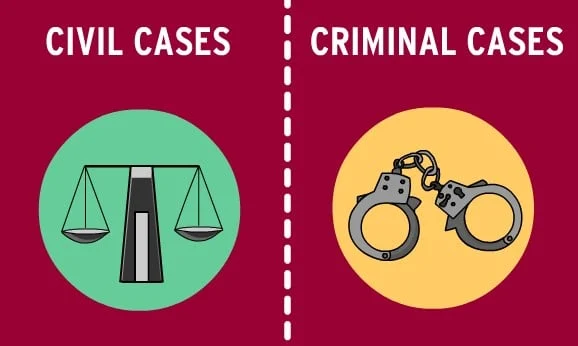
Civil law handles disagreements between people, businesses, or groups. It applies when one person says that another person hurt them or didn’t do their legal duty. This includes disagreements over contracts, claims of wrongful termination, disagreements between landlords and tenants, and personal injury cases. The goal is not to punish, but to find a solution. Most of the time, that resolution comes in the form of payment, making someone do something they promised to do, or formally recognizing someone’s rights.
Criminal law works on a different level. It talks about actions that are bad for society as a whole. Even if there is a clear victim, theft, assault, fraud, and murder are not considered private matters. The state acts as the prosecutor, saying that a crime against the public has been committed. The process is based on punishment, deterrence, and making the public responsible.
The standard of proof is where the line between the two becomes clear. In civil cases, judges or juries make decisions based on what is most likely to be true. In practical terms, this means figuring out which story is more likely to be true. Fifty-one percent is all you need. Criminal law requires proof beyond a reasonable doubt, which is a very high standard because the consequences of being wrong are so serious.
This difference is not just a theory. It makes the mood in a courtroom different. Civil cases are usually quieter and more formal, and they can even be boring at times. It’s hard to miss the tension that comes with criminal trials. Liberty, reputation, and occasionally life are jeopardized.
I once saw a civil case about a failed business partnership go on for months, with each disagreement being looked at with calmness. In the same week, a criminal case ended in two days with a verdict that made the room silent.
The roles of the parties are also different. People in civil law can sue each other and decide whether to settle, keep going, or drop the case. In criminal law, the victim’s wishes are no longer important once the state takes charge. Even if the person who was hurt doesn’t want it to happen, the prosecution can still go on.
It’s scary to lose control like that. A lot of people who have been victims in criminal trials say they feel pushed to the edges and turned into witnesses in their own story. In civil lawsuits, claimants often feel a different kind of frustration when costs and delays start to add up and they wonder if justice is even possible.
The courts themselves make the difference even clearer. The High uk Court and County Courts deal with civil cases, where the files get bigger and the arguments are based on past cases and how they are understood. The Crown Court and Magistrates’ Courts handle criminal cases that are based on guilt, innocence, and sentencing. The language even changes. The person who files a claim and the person who defends it become the prosecution and the defense.
The results are clear. A civil judgment can tell someone to pay damages, stop doing something, or do something specific. You could get a fine, a community service order, or jail time if you are found guilty of a crime. One process tries to fix something. The other wants to punish wrongdoers and make them pay.
It’s not always clear where one ends and the other begins. A single event can lead to both civil and criminal cases. If you attack someone, the state may charge you with a crime and you may be able to sue them for damages. The outcomes may vary and even conflict with one another. People who are new to the system may be confused by the fact that someone can be found not guilty in criminal court but still be liable in civil court.
The difference in goals and standards of proof is what makes sense. On purpose, criminal law is careful and would rather let someone go than risk convicting them wrongly. Civil law puts fairness between parties first, even when it’s hard to be sure.
This duality can make you feel uneasy. It implies that truth is not absolute, but contingent upon context. What can be proven beyond a reasonable doubt is not always the same as what is more likely than not.
The pace is also different. Civil cases can take a long time because of negotiations, disclosures, and other steps that need to be taken. The need for finality, public interest, and limits on custody all help move criminal cases along. No rhythm works for everyone. One can feel like it’s going too fast, and the other can feel like it’s going on forever.
Lawyers’ minds change in the same way. Civil lawyers talk about risk, strategy, and fairness. Criminal lawyers deal with things like the burden of proof, failure to disclose, and how the jury sees things. Both have to follow strict rules, but the emotional weight of the work is different.
People often don’t see these differences clearly. Headlines mix up civil settlements and criminal responsibility. People think fines are a form of punishment. People think that being found not guilty clears someone’s name completely. Nuance goes away, and so does a clear idea of how the system is supposed to work.
In the UK, civil and criminal law are not moral rankings. It is a structural division that is meant to handle different types of conflict. One deals with wrongs done to individuals. The other one talks about harm to the public. Both depend on judgment, evidence, and human decision-making, which isn’t always perfect.
It’s quietly impressive how well the two systems work together. They cross paths, sometimes clash, but very rarely fall into each other. That separation protects people by limiting the state’s power in private disputes and keeping private revenge in check when it comes to public issues.
Knowing these legal terms doesn’t make dealing with the law any easier, but it does make it less confusing. It explains why some cases end with checks and others with sentences, and why some disagreements seem open to negotiation while others seem final.
The law shows that society is trying to find a balance between fairness, order, and restraint in both forms. The balance changes over time, but the difference stays the same. It is one of the quiet structures that make up everyday life. People only notice it when it breaks down, but it is important because it usually doesn’t.