

Construction workers are silently putting together what appears to be a collection of enormous warehouses on the outskirts of Phoenix, Arizona, where the dry metallic odor of sun-baked infrastructure permeates the desert air. The buildings don’t look particularly noteworthy from a distance; they have gray walls, flat roofs, and parking lots that gleam in the sunlight.
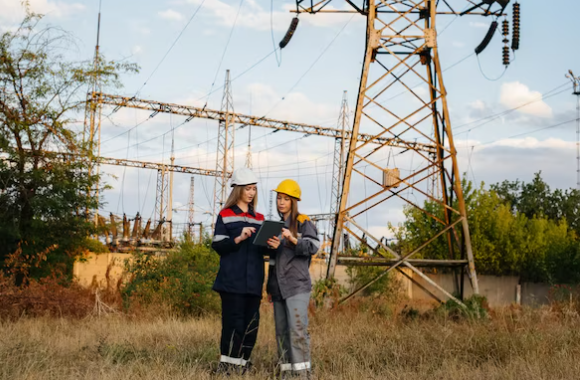
However, the scale becomes more apparent as you go closer. Nearby, football-field-sized substations hum faintly. Like steel arteries, thick transmission wires crisscross the terrain. It’s neither a factory or a mall that’s sprouting here. The facility is an AI data center.
Key Information About the Power Grid Strain
| Category | Details |
|---|---|
| Topic | Global Power Demand from AI Data Centers |
| Central Issue | Massive electricity demand from AI infrastructure |
| Estimated U.S. Data Center Power Use by 2030 | Up to 108 Gigawatts |
| Current Share of U.S. Electricity | ~4% (2023) |
| Projected Share | Up to 15% by 2030 |
| Typical AI Data Center Demand | 100+ MW per facility |
| Infrastructure Problem | Aging transmission lines and transformer shortages |
| Upgrade Timeline | 5–15 years for major grid expansions |
| Key Industries Involved | Big Tech, utilities, grid operators |
| Reference |
Over 100 megawatts of power, or around what a sizable American city might use, can be consumed by each of these plants. The amounts start to seem almost unreal when you multiply it by the dozens of projects that businesses like Microsoft, Amazon, Google, and Meta are planning. It has been known as “the 30-gigawatt question” by energy planners.
The term describes the massive amount of additional electrical power that may be required by global grids simply to keep up with artificial intelligence. According to some predictions, the computational power needed to train massive AI models might cause the demand for electricity in U.S. data centers to quadruple to almost 108 gigawatts by 2030. Even such forecasts might be conservative, though.
There is a general feeling among utilities and regulatory bodies that demand is growing faster than the actual state of power infrastructure. Planning and construction of transmission lines can take years, perhaps over ten years. Transformers can take two or three years to produce and require specialized manufacturing. Silicon Valley, meanwhile, is moving at software speed.
Power engineers sometimes compare the grid to a highway during rush hour in northern Virginia, which already has the biggest concentration of data centers in the world. All of the lanes are occupied. There is constant influx of new traffic. Additionally, creating new lanes is not easy.
In the United States, a large portion of the electrical infrastructure was constructed decades ago. A few transmission lines are from the 1970s and 1980s. They were not made for a future of supercomputer clusters running AI models all day and night, but rather for a world of factories, residences, and office buildings. It’s difficult to overlook the disconnect between digital ambition and physical constraints as this change takes place.
Artificial intelligence has exceptionally high needs. Thousands of specialized chips may need to run continuously for weeks in order to train a single huge AI model. Large amounts of heat are produced by these chips, necessitating industrial cooling systems that use even more electricity.
AI workloads can fluctuate abruptly, in contrast to typical factories that run at constant power levels. Power demand can fluctuate by tens or even hundreds of megawatts in a matter of seconds as large-scale computing processes begin or end.
According to grid operators, older electrical systems were not built to handle the stability issues caused by frequent swings. As a result, cloud computing and electric utilities—two sectors that previously rarely interacted closely—are now experiencing an odd new friction. Utilities typically make plans decades in advance. Tech firms frequently make plans for the upcoming quarter. Already, some of the biggest internet companies are acting independently.
Google has spent billions on data center-related renewable energy projects. According to reports, Meta has looked into nuclear energy collaborations. In order to ensure electricity for upcoming AI workloads, Amazon, through its cloud division, has been assessing long-term power supply strategies.
There is a perception that large internet companies are starting to behave more like energy developers and less like grid consumers. The effects may manifest subtly for customers in the form of higher electricity costs.
To handle enormous data center loads, utilities must make significant investments in new infrastructure. These expenses are shared by all clients in some areas. Analysts caution that if upgrades pick up speed, electricity costs in some markets may increase dramatically. Residential electricity bills in certain areas may eventually increase by as much as 20–25 percent, according to some estimates. The environmental issue comes next.
Businesses in Silicon Valley often highlight their dedication to renewable energy. However, those promises are complicated by the rapid growth of AI. In many locations, utilities are turning to natural gas facilities as the quickest method to increase power capacity because solar and wind projects take time to deploy. Climate pledges from the tech sector are at odds with that reality.
Engineers now watch electricity flows with increasing attention to data centers in dimly lit control rooms at utilities around the nation, which are loaded with bright monitors. On grid maps, these facilities show up as big, consistent loads that frequently rival entire towns. Electricity has always been necessary for the digital economy. There was never any question about that.
The scale is currently changing. A new type of industrial need has emerged as a result of the development of artificial intelligence, one that is more rapid than infrastructure can readily adjust to. The demand for processing power in Silicon Valley continues to grow, and the physical grid beneath it strains—sometimes uncomfortably—to keep up.
