
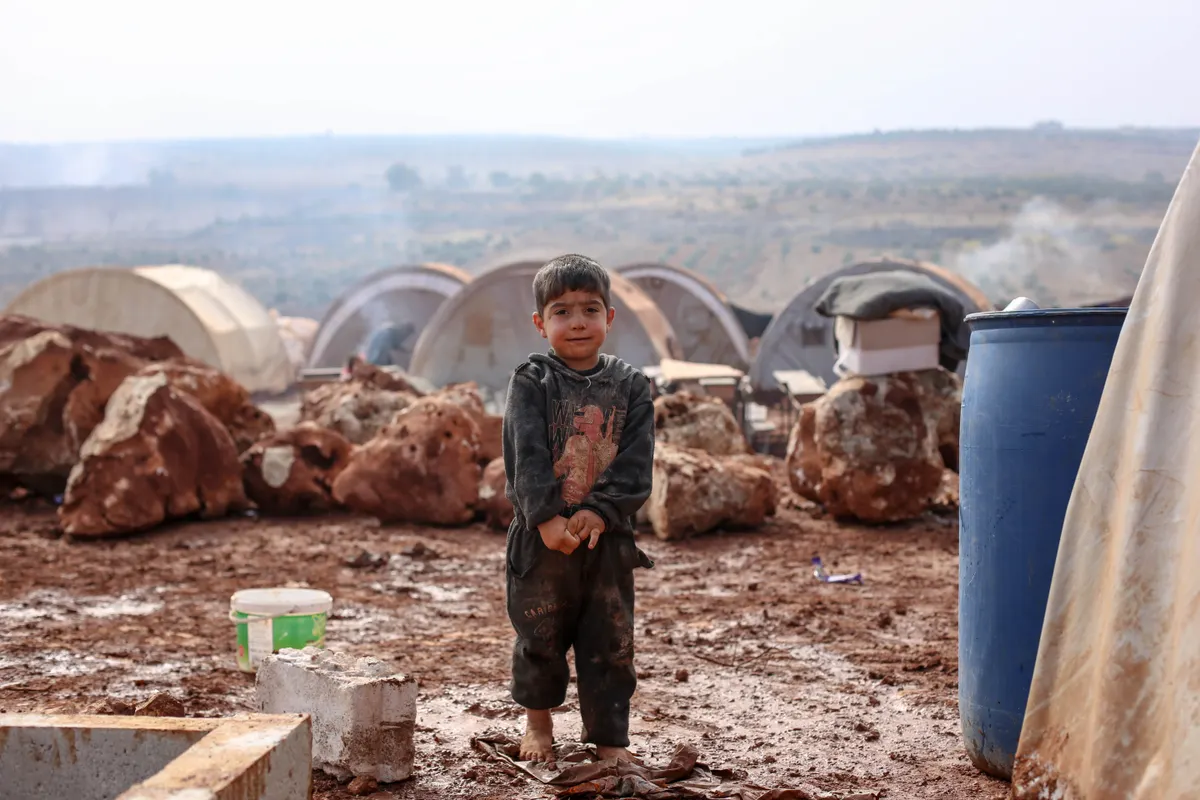

A surge in hostilities across Yemen has driven a Yemen children displacement crisis that UNICEF says has uprooted more than 57,000 children in just two weeks, compounding what the agency describes as one of the gravest humanitarian emergencies in the world. The warning came on Thursday as fresh violence added acute pressure to a country already hollowed out by a decade of civil war, economic collapse, and a healthcare system at breaking point.
Yemen Children Displacement: Scale of the Crisis
Edouard Beigbeder, UNICEF‘s regional director for the Middle East and North Africa, set out the human cost directly. ‘Children in Yemen were already living through one of the world’s most grave humanitarian crises, and many have known little but conflict and displacement … Now, tens of thousands of families have been forced from their homes in just two weeks, many fleeing only with what they can carry. For children who have already endured years of hunger, displacement and disrupted schooling, this latest violence is eroding what little stability they had left.’
Since early September 2026, at least nine children have been killed, twelve injured, and three remain missing. Those losses sit within a far larger toll: since the conflict began in 2015, UNICEF records more than 11,500 children killed or maimed, comprising specifically 3,900 killed and 7,600 maimed.
The disruption to essential services runs in parallel. Twenty-six healthcare facilities supported by UNICEF have been taken out of operation, while 243 schools have either closed or are functioning only partially, affecting the learning of at least 137,000 students. Wider than that snapshot, UNICEF’s 2025 Global Annual Results Report puts the total number of children out of school in Yemen at at least 3.7 million, a figure driven by conflict, displacement, poverty, child labour, and child marriage.
UNICEF and its partners have distributed more than 57,000 Rapid Response Mechanism kits across 21 governorates, reaching over 400,000 newly displaced people. Urgent sanitation support, hygiene kits, and water tanks are also being supplied to families on the move.
Internal Displacement and the Dangerous Crossing to Djibouti
The scale of movement inside Yemen is itself contested between two agency assessments. A UNHCR emergency update dated 22 September 2026 puts internal displacement at close to 130,000 people, while a separate inter-agency refugee response plan cites more than 142,000 displaced within Yemen during the current resurgence of hostilities. The higher figure comes from the inter-agency plan; the UNHCR emergency update is the more recent single-agency assessment. Displaced families have been scattered across the governorates of Al Hodeidah, Ta’iz, Lahj, Aden, Abyan, Marib, Al Dhaleh, and Shabwah.
A separate and perilous outflow is crossing the Bab el-Mandeb Strait. Since early September 2026, approximately 3,000 refugees have arrived in Djibouti through the entry points of Obock, Khor Angar, Moulhoule, and Godoria, according to the UNHCR emergency update. UNHCR reports that more than 60 per cent of those arrivals are women, children, and older people, and that further departures from Yemen appear to be in preparation.
The crossing itself carries severe risks. UNHCR has identified exposure to human traffickers, communicable illnesses including scabies from overcrowded settlements, the risk of drowning from unseaworthy boats, and family separation as the principal dangers. Children who attempt the route in summer face air temperatures that can reach 122°F and surface water temperatures that average above 68°F annually, conditions that have proved fatal for those who develop heat stroke before reaching the Djiboutian shore.
UNHCR has called urgently for additional support for those already in Djibouti, where reception capacity is under strain.
A Conflict a Decade in the Making
The roots of the crisis reach back to the political upheaval of 2012, when mass protests against President Ali Abdullah Saleh’s government led to his resignation and a transitional process that the Houthi movement, a Zaydi Shia group which had already fought six wars against the central government between 2004 and 2010, rejected as exclusionary. The Houthis launched an insurgency that escalated into full civil war in September 2014, and into a regional conflict in March 2015 when Saudi Arabia and the United Arab Emirates intervened militarily to restore the internationally recognised government.
Human Rights Watch has previously documented Houthi recruitment of child soldiers, a practice that violates Article 77 of Additional Protocol I to the Geneva Conventions and Article 38 of the UN Convention on the Rights of the Child.
With internal displacement figures still rising and UNHCR warning that further cross-border movement is likely, the next weeks will test whether the inter-agency response plan can mobilise resources fast enough to keep pace with the Yemen children displacement crisis as it widens.
