
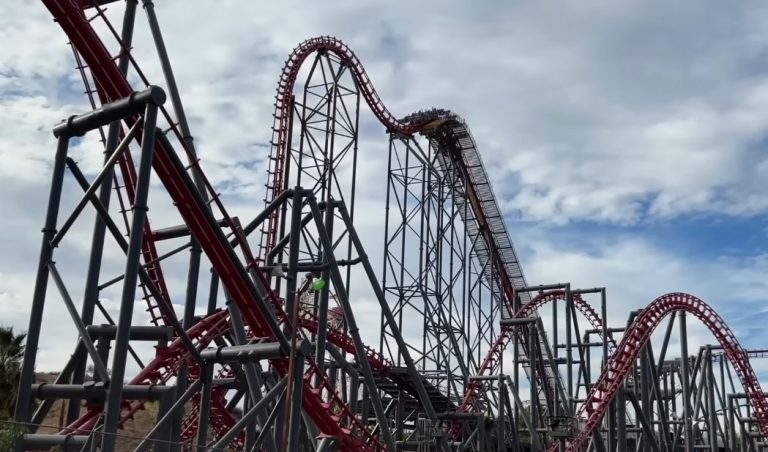
A lawsuit that will go to trial on September 8 in Chatsworth, California, centers on what transpired in between. The Hawley family of Garden Grove is suing Six Flags Magic Mountain, the company that makes the X2 roller coaster, as well as a number of specific park workers. The family claims that the ride was poorly designed and that the public was not sufficiently informed of the risks associated with X2.
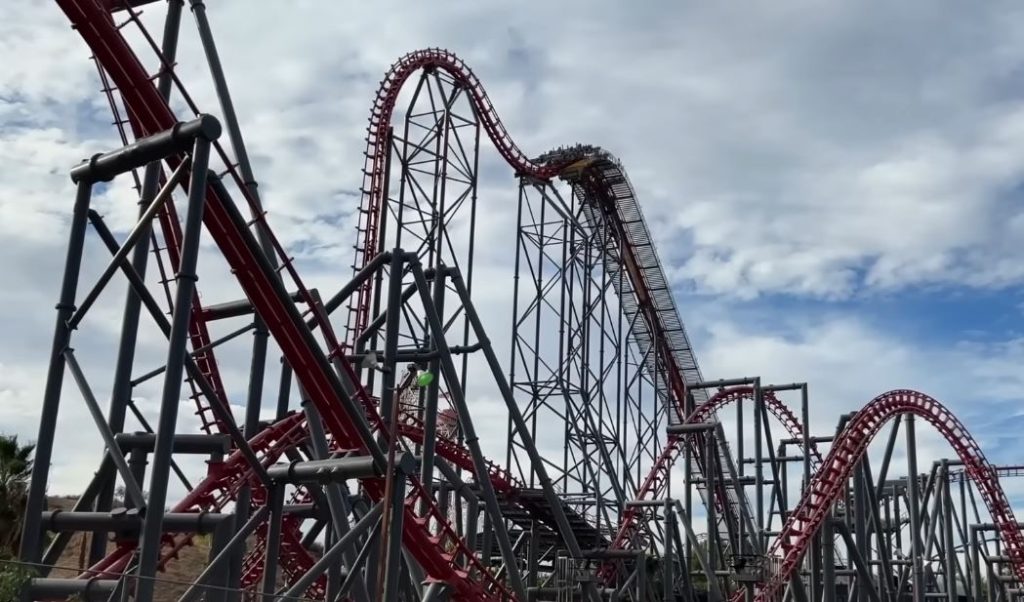
X2 is not a low-key attraction. Constructed by Arrow Dynamics, it was the first “fourth-dimensional” roller coaster in history. It made its debut in 2002 and underwent significant renovations in 2008. While the train speeds up to 76 miles per hour while racing through drops and inversions along 3,600 feet of track, passengers are seated in 360-degree rotating seats. According to the park’s own website, it keeps visitors in “total sensory overload.”
The coaster “suddenly, abruptly and violently jolted to a halt,” snapping all three passengers in their seats as Christopher and his friends approached the end of the ride, according to the lawsuit. The way the coaster jerked them around, then propelled them forward before their heads swung back hard into the headrests is how Alex described the physical experience in terms that are difficult to forget. He said it wasn’t thrilling. It had a violent vibe.
Christopher didn’t look right after leaving. He had a very red face. He was moving haltingly down the ramp while clinging to the handrail. His head hurt, he told his brother. Then he fell to his knees, slumped, and passed out.
He was taken to Valencia’s Henry Mayo Newhall Hospital by emergency personnel. A catastrophic subdural hematoma, or bleeding between the brain and its outer layer, was discovered by a CT scan. William, Christopher’s father, claims that the treating surgeon likened the internal damage to “shaken baby syndrome.” William told FOX 11, “The ride hit his head so hard that it had basically ruptured his brain.” The next day, Christopher passed away.
Blunt head trauma from a park ride accident was the cause of the death, according to the Los Angeles County Medical Examiner, who declared it an accident. The family is essentially basing their case on that ruling. The defense may contend that warnings were adequate, that the ride operated as intended, or that personal physiology was involved. Whether Six Flags or the manufacturer had any prior knowledge of structural or design issues unique to X2 prior to that June afternoon is still genuinely unknown.
The loss was described as simply as possible by Christopher’s mother. “We went from a family of four to a family of three in an instant,” she replied. “It’s terrible. It is a part of us that will never return.
This trial feels more urgent because of an additional layer of context. Four years after Christopher’s incident, on July 5, 2026, a rider on X2 was discovered unconscious. Cal/OSHA initiated an inspection. Since July 12, the ride has been closed. Other than confirming the closure, Six Flags has not made any public statements. As the main trial draws near, the manufacturer’s coaster train supplier has independently requested judicial approval of a settlement with the Hawley family, indicating that some parties may be working toward a resolution.
Here, it’s difficult to ignore the pattern that is emerging. Years apart, two riders are unconscious on the same attraction. A ride that advertizes its sensory extremity. And a family who had to wait four years to get to court.
As this case develops, there’s a sense that it might raise more general concerns about how theme parks convey risk—not just through waiver signs and height restrictions, but also through frank evaluation of the actual effects of extreme mechanical forces on human bodies at high speeds. The intensity of the X2 is not unique. However, the Hawley lawsuit raises a specific and unsettling question: what is a park’s duty of care when it invites visitors onto a machine that can use this kind of force?
On September 8, the trial will start. Christopher Hawley, a 22-year-old college graduate with a younger brother, had to call their mother from a theme park ramp to report that his brother wasn’t waking up, regardless of the jury’s verdict. There is no question about that part.