

For nearly a century, a certain section of the National Mall—between the white obelisk of the Washington Monument and the columns of the Lincoln Memorial—has been ingrained in American visual memory. When it was finished in 1923, the Reflecting Pool was not intended to shine. It was carefully planned to vanish. In order for the water’s surface to reflect the sky, the marble, and any adjacent rituals, marches, or lone guests, the architects carefully selected a dark, achromatic basin. That subdued gray was deliberate. The Cultural Landscape Foundation filed a complaint on Monday, claiming that “it was the design.”
In a city accustomed to legal battles over the president’s instincts as a former real estate developer, the complaint asks a federal judge to stop the Trump administration’s ongoing renovations of the pool. The renovation is being overseen by the Department of the Interior, which has begun recoating the basin with what is essentially an industrial pool-deck material in a considerably brighter blue, more akin to what one might see at a Florida resort than at a presidential memorial.
The National Historic Preservation Act, a 1966 statute that requires particular procedural criteria before major changes may be made to federally protected historic sites, is allegedly violated by this, according to the foundation. The primary legal question now is whether the Interior Department adhered to those protocols.
| Information | Details |
|---|---|
| Plaintiff | The Cultural Landscape Foundation |
| Defendant | U.S. Department of the Interior |
| Filing Type | Federal lawsuit, emergency injunction sought |
| Site at Issue | Lincoln Memorial Reflecting Pool |
| Pool Length | 2,030 feet |
| Original Cost Estimate | Up to $2 million |
| Current Federal Award | $13.1 million |
| Initial Contract Amount | $6.9 million |
| Contractor | Atlantic Industrial Coatings (Virginia firm) |
| Contract Type | No-bid, emergency exemption |
| Project Deadline | May 22, 2026 |
| Legal Basis | National Historic Preservation Act |
| Previous Renovation | 2010–2012, $34 million under Obama |
| Stated Motive | Remarks by a German friend of Trump’s |
| Related Pending Case | White House ballroom construction |
| Anniversary Tie-In | America’s 250th birthday, July 4, 2026 |
| Public Reaction | Sharply divided |
The money, on the other hand, has a peculiar arc of its own. At first, Trump informed the public that the project may cost as much as $2 million. The original contract was worth $6.9 million. The total rewards for the job, according to federal records, are $13.1 million, which is more than six times the president’s initial estimate. Atlantic Industrial Coatings, a Virginia company, won the contract on a no-bid basis under an emergency exemption.
Critics have pointed out that, even by federal contracting regulations, it is rare to invoke an emergency exemption to avoid competitive bidding procedures when the underlying product is an ornamental reflecting pool whose maintenance problems have been known for more than ten years. There might have been a legitimate procurement justification. Or perhaps there wasn’t. In any case, the complaint includes the procurement issue in the larger dispute about whether the law was obeyed.
In a sense, the most subtly illuminating aspect of the narrative is the reason Trump provided for the project. He has repeatedly informed reporters that a buddy from Germany had complained that the pool was “filthy, dirty,” that the water was “disgusting,” and that it was “not representative of the country.” The initiative seems to have started with that remark, which was made at an unidentified period by an anonymous visitor. As work started, the president’s motorcade unexpectedly stopped by the location. Anyone observing how this White House functions has grown accustomed to this type of decision-making, when a single casual comment may result in a $13 million federal contract.
The legal context is also important. On March 31, a federal judge issued an order prohibiting above-ground construction of Trump’s proposed White House ballroom, stating that “construction has to stop until Congress blesses this project through statutory authorization.”” After an appeal, the injunction was later removed, allowing building to resume while the case is still pending. It is highly likely that the reflecting pool lawsuit for the Cultural Landscape Foundation will take a similar course. emergency injunction. review of appeals. Years of court cases. The contract stipulates that the work must be finished by May 22, which is just a few weeks before America’s semiquincentennial on July 4.
The pool was restored with a contemporary circulation and filtration system during the $34 million refurbishment, which was finished under President Obama between 2010 and 2012. By all accounts, it did not completely resolve the fundamental issues. Leaks continued. In the summer, algae bloomed. Bird droppings piled up. The pool’s surface is rarely as calm as the photos depict, as anyone who has strolled along its edge in August would attest.
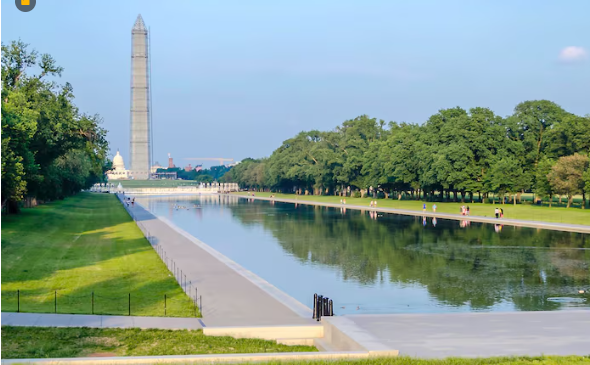
The Trump administration essentially argues that these problems are finally resolved by this new endeavor. Preservationists contend that even if the maintenance work is warranted, the cosmetic decision to change the hue is not, and that the legal measures intended to prohibit such unilateral alteration are circumvented by the procedural short cuts used to get the work done.
It’s difficult to ignore the cultural undertone as this develops. One of the few places in America that practically everyone, regardless of political affiliation, acknowledges as shared is the National Mall. Some of the most photographed occasions in American civic life have used the reflecting pool. With the pool extending behind him,
Martin Luther King Jr. gave the I Have a Dream speech. In the 1970s, anti-war protesters entered the fray. Vigils, memorials, inaugurations, and regular tourist pictures all take place against its surface. A portion of shared visual memory is altered when the water’s color is changed, even for what the administration refers to be aesthetic purposes.
Walking past construction barriers on the Mall this spring gives the impression that a decision is being made in public without much discussion. The action will proceed in court, and the decision might not be made in time to stop the pool from being completed in its new hue. The basin between Lincoln and Washington might just appear different by July 4—brighter, less reflecting, and less like itself. The Cultural Landscape Foundation is now requesting that a federal judge determine if that is replacement or restoration.
