
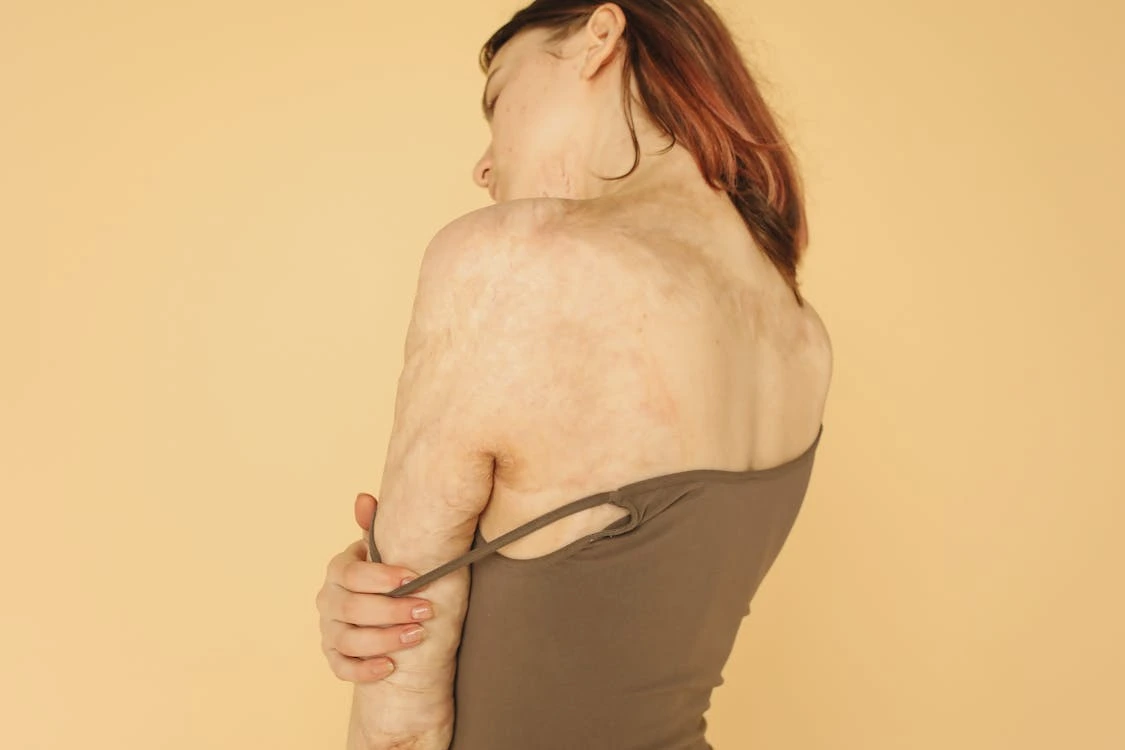

Nearly 486,000 Americans get medical treatment for burn injuries every year. Survival rates have climbed dramatically thanks to better acute care — but what comes after? The long road of scar recovery is where most people feel abandoned, confused, and underprepared. Understanding how collagen fibers arrange themselves in a haphazard, cross-linked pattern during burn healing isn’t just biology trivia. It’s the starting point for every decision you’ll make about your skin over the next several years.
Here’s what most people don’t hear in discharge paperwork.
How Burn Scars Actually Form
The moment thermal damage hits, your body kicks off a repair process that’s equal parts impressive and chaotic. Within hours, immune cells and growth factors flood the injury site. That inflammatory response is necessary — it clears debris, fights infection. But push it too hard, and it sets off excessive collagen overproduction. That’s when problems start.
Three to six weeks out, fibroblasts begin laying down new collagen. This is the critical window. In a normal healing wound, collagen fibers run in organized, parallel lines. Burn wounds? Different story entirely. The collagen fibers arrange themselves in a haphazard, cross-linked pattern — tangled, disorganized, pulled in every direction. The result is that raised, tight, often discolored tissue that refuses to behave like normal skin.
And then remodeling begins. That phase can stretch 12 to 24 months. The scar softens — somewhat. But burned tissue never fully resets. Different collagen ratios, missing elastin fibers, disrupted nerve endings. Some of those changes are permanent.
Early intervention matters for exactly this reason. The inflammatory and early proliferation phases are your best window to shape how that collagen organizes itself. Miss it, and you’re dealing with a much harder problem.
Not All Scars Are the Same
Three main types, three very different challenges.
Hypertrophic scars stay within the original burn boundary. Raised, firm, red or pink — they often itch badly enough to disrupt sleep. The good news: they tend to improve over time and respond reasonably well to conservative treatment.
Keloid scars don’t stay put. They push past the original wound edges, keep growing for months or even years, and cause persistent pain and tenderness. They’re notoriously stubborn — surgical removal carries a high recurrence rate.
Contracture scars are the ones that steal function. They form when scar tissue tightens over joints or large surface areas, pulling surrounding skin inward. Specialized cells called myofibroblasts contract during healing but never properly relax — creating a progressive tightening that can essentially freeze a joint in place.
The catch with contractures? They worsen without intervention. Unlike cosmetic concerns, these create real disabilities — affecting work, self-care, quality of life. For survivors managing complications from an initial injury, getting burn injury compensation help is often what makes accessing that level of specialized care financially possible in the first place.
Daily Skincare That Actually Moves the Needle
Consistency beats intensity here. Small, sustained daily actions over months outperform sporadic intensive treatments every time.
Moisturization first. Scar tissue loses moisture faster than normal skin — dryness triggers itching, itching worsens the scar, inflammation slows healing. That cycle is brutal and avoidable. Thick, occlusive formulas with petrolatum, ceramides, or hyaluronic acid work best. Not the light stuff.
Massage, but done right. Small circular motions, moderate pressure, 5-10 minutes twice daily — across the grain of the scar tissue, not along it. Cross-fiber pressure stretches and softens those disorganized collagen fibers responsible for stiffness. Only start after the wound is fully closed, and back off if redness increases.
Temperature awareness. Scar tissue lacks the normal nerve and vascular infrastructure that manages thermal sensation. Hot water, heating pads, prolonged sun — all riskier than they’d be on unaffected skin. Many survivors describe their scars as living weather barometers. That sensitivity doesn’t fully go away.
Pressure Therapy and Silicone: The Evidence-Based Tools
Pressure garments — worn 18 to 23 hours daily for 12 to 18 months — work by creating sustained compression that limits blood flow to healing tissue just enough to slow excessive collagen synthesis. Custom-fitted versions matter here; too loose and it’s doing nothing, too tight and it causes breakdown. Expect replacements every 3 to 6 months as swelling reduces.
Silicone gel sheets and topical silicone products take a different route. The exact mechanism isn’t fully mapped, but silicone maintains hydration, reduces bacterial load, and likely influences local growth factor activity. It’s less demanding than pressure therapy — more flexible to schedule, easier to wear. Gel sheets struggle to conform to curved surfaces or joints; topical gels handle irregular areas better but need more frequent reapplication.
Sun protection deserves more attention than most people give it. The melanocytes in scar tissue respond unpredictably to UV — sometimes producing both hyperpigmentation and hypopigmentation within the same scar simultaneously. Zinc oxide-based SPF 30+ products tend to irritate less than chemical alternatives. And clothing beats sunscreen every time when covering the area is an option.

When to Escalate to Medical Treatment
Conservative care has limits. Scars that restrict movement, cause ongoing pain, or meaningfully affect quality of life warrant a proper clinical evaluation.
Fractional laser treatments target specific problems depending on the type used — pulsed dye lasers for redness and vascularity, CO2 or erbium lasers for texture and bulk. Multiple sessions, spaced 4 to 6 weeks apart. Expect things to look worse before they improve. Not every scar responds equally; timing and skin type matter.
Surgical revision becomes relevant when conservative measures fall short — particularly for contractures limiting function. The goal isn’t scar removal (that’s rarely achievable) but repositioning, size reduction, or functional release. Good candidates have mature scars, at least 12 to 18 months old, and clear-eyed expectations. Surgery carries a real risk: new scars can be just as problematic as the originals.
The Part Nobody Talks About Enough
Burn survivors experience higher rates of depression, anxiety, and social withdrawal than the general population — and that holds regardless of how large or severe the visible scarring actually is.
Body image disruption hits even when scars are relatively minor. Many people describe feeling like strangers in their own skin, particularly in that first year when everything is still actively changing. Social situations become minefields — the stares, the questions, the people who try too hard not to look. Building standard responses to common questions and gradually increasing exposure in supportive settings both help, but they take time.
The longer arc tends toward adaptation and resilience. But that arc moves faster with real support — counseling, peer mentorship, burn survivor groups. Emotional healing deserves the same investment as the physical kind.
Recovery isn’t a straight line. The collagen fibers arranging themselves in a haphazard, cross-linked pattern during those early weeks? That process shapes your skin for years. Knowing it — and acting on it early — changes what’s possible.
