
Judge Shopping in Texas and the Numbers Behind the Shift
The Brennan Center for Justice has drawn a useful distinction here: forum shopping involves selecting a district’s pool of judges, whereas judge shopping exploits single-judge divisional assignments to hand-pick a specific jurist. The Northern District of Texas’s Amarillo division, with its single active judge, became a textbook example of the latter.
That practice has, however, been curtailed. In March 2024, the Judicial Conference announced a policy requiring random case assignment for national-injunction cases filed in single-judge divisions, as detailed by the Federal Bar Association. The practical effect has been measurable. A peer-reviewed study in the Journal of Empirical Legal Studies found that case filings in the Western District of Texas fell by dozens of cases per period examined following the change in assignment practices.
Broader federal caseload data reinforce the picture. According to Federal Judicial Caseload Statistics 2025 published by the United States Courts, combined civil and criminal filings in district courts fell by 68,580, a drop of 17 per cent, to 345,446 in the year to 2025. Civil filings alone fell 22 per cent to 271,802. The pattern of high-volume political litigation clustering in Texas courts has visibly decelerated.
The Other Side of the Forum: Liberal Districts Under Scrutiny
What the Times piece leaves unexamined is the mirror dynamic in the District of Massachusetts and the District of Rhode Island, where progressive litigants have pursued challenges with a high degree of confidence about which ideological corner of the federal judiciary they will reach. Random assignment in those districts does not resolve the concern when every judge in the relevant pool shares a comparable judicial disposition: the numerator and the denominator are, in effect, the same.
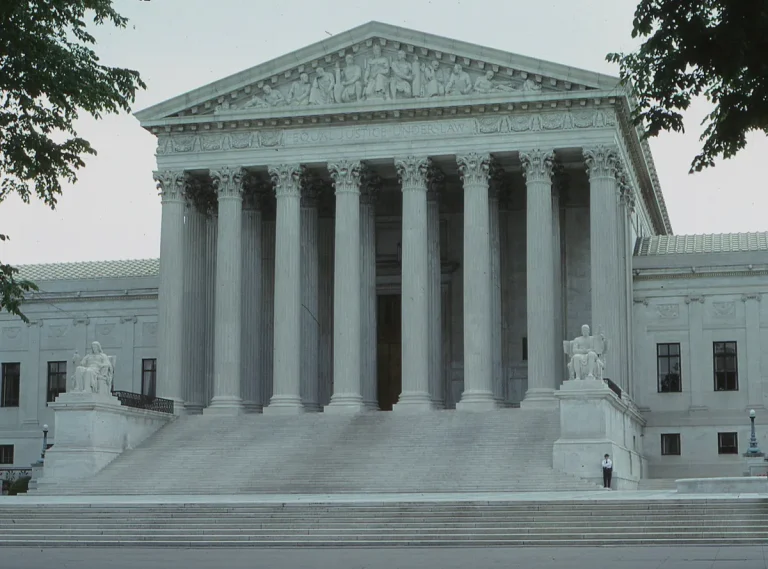
The record of the Massachusetts bench during the current period of litigation over executive action offers concrete illustration. District Judge Talwani has had two significant orders stayed by the Supreme Court in relatively short succession. On 30 May 2025, the court stayed her order pausing the Trump administration’s parole programme terminations in a 7-2 decision, with Justices Ketanji Brown Jackson and Sonia Sotomayor dissenting, according to Ballotpedia. A second stay of a Talwani injunction followed on 24 August 2026, the court finding that the underlying order had not yet been carried out.
The conduct of another Massachusetts judge in related litigation attracted equally pointed Supreme Court intervention. When the court stayed his April 18 preliminary injunction, that judge issued an electronic docket order the same day asserting his May 21 order ‘remains in full force and effect, notwithstanding’ the stay, citing Justice Sotomayor’s dissent. The Supreme Court responded on 3 July 2025 with a second order, carrying a 7-2 majority, clarifying that its earlier ruling ‘stayed the April 18 preliminary injunction in full’ and that the May 21 order ‘cannot now be used to enforce an injunction that our stay rendered unenforceable.’ The full account of that exchange is reported by the Center for Immigration Studies. Justice Sotomayor dissented alongside Justice Jackson.
The question of whether a district judge may effectively neutralise a Supreme Court stay by issuing a subsequent order on a parallel basis is not an academic one. The July 2025 ruling answered it directly, and in terms that leave little ambiguity about the court’s tolerance for that approach.
A consistent standard of scrutiny, applied equally to conservative forum selection in Texas and to the near-certain liberal draws available in Boston or Providence, would make for a more complete account. The next significant test of how district courts respond to Supreme Court stays, subject to any onward appeal in active cases, is likely to arrive before the end of the current term.