
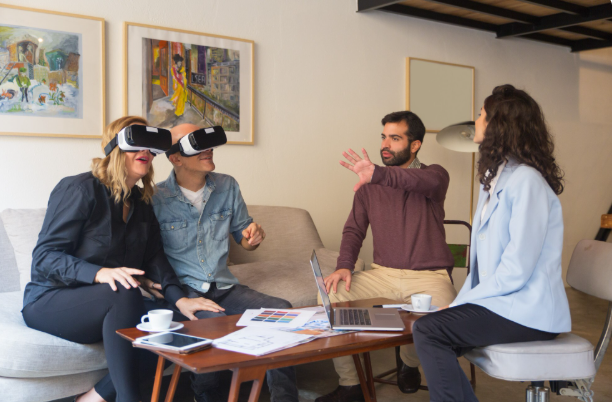

Wearing a virtual reality headset while talking about pensions has a little weird feel to it. After all, retirement planning has traditionally been the purview of cautious spreadsheets, grey files, and courteous but somewhat monotonous talks held in offices with glass walls all around the City of London. According to a UK business, more paperwork isn’t the answer to Britain’s retirement worry. Immersion is what it is.
It’s almost a dramatic pitch. Users enter a digital future — a sort of customized “A Christmas Carol” for their finances — rather than gazing at anticipated income charts. Put on the headset and you can picture yourself walking through a tiny apartment at the age of 68 because you didn’t save enough money. Or maybe walking along a sunny beach because you made smart investments and started sooner.
| Category | Details |
|---|---|
| Sector | Fintech / Retirement Planning |
| Technology | Virtual Reality (VR) & Augmented Reality (AR) |
| Notable Industry Player | St. James’s Place |
| Emerging Fintech Peer | Jarvis |
| Target Market | UK savers, particularly over 50s |
| Industry Regulator | Financial Conduct Authority |
| Reference | https://www.fca.org.uk |
It is possible that this initially seems gimmicky. However, it is impossible to overlook how abstract the discussion frequently becomes when attending standard pension seminars. The percentages are hazy. The emotional impact of compounding is diminished. On paper, a £200,000 retirement shortfall seems inconceivable, but in reality, it is horrifying.
Demo headsets sit next to reusable coffee mugs on a spotless white table in a small Shoreditch co-working space. The founders claim to be selling “engagement metrics” and “behavioral nudges,” but in reality, they are selling emotional clarity. According to reports, one prototype scenario enables users to modify contributions in real time and observe how their retirement environment changes from crowded and unpredictable to secure and cozy.
It’s enlightening to watch someone attempt it. When anticipated income declines, shoulders become stiff. As virtual assets increase, posture becomes more relaxed. Before the mind can reason, the body responds.
The startup seems to be placing a wager on something more significant than technology. They’re speculating that people don’t fail to save because they’re careless, but rather because they don’t think the future is real.
This gap has long been a problem for financial advisors. In order to better comprehend their vulnerable customers, firms like St. James’s Place have experimented with using virtual reality (VR) for empathy training. Although the application is different, the concept is the same: make the invisible apparent.
The pension system in the UK is complicated. Although participation has increased due to auto-enrollment, contribution levels are still quite low. The Financial Conduct Authority is still warning about middle-class consumers in particular not saving enough money. Is it possible for a headset to actually alter such behavior?
Immersion technologies appear to be part of a larger fintech wave, according to investors. Another firm in the UK that focuses on retirement, Jarvis, recently secured £1.8 million to leverage app-based data to simplify pension consolidation and budgeting. That method seems more gradual and recognizable. VR seems bolder.
It’s still uncertain if elder savers will accept virtual reality technology easily, especially those over 50 who stand to gain the most from more precise planning. It might be empowering to some. Others may view it as superfluous entertainment added to important choices.
One user apparently took off the headgear in the middle of a pilot demonstration, clearly upset by the low income estimate. That response begs the question. Is fear a good motivator, or may it work against you?
The process of planning for retirement is already emotionally taxing. The subject causes silent worry for many Britons, particularly following years of inflation and economic uncertainty. The founders of the firm contend that visualizing truth is healthier than ignoring it.
Visualization is becoming more and more important in modern finance; apps are replacing binders, and dashboards are replacing ledgers. The next logical step is to be to extend that development into immersive settings. However, natural does not necessarily imply necessity.
Storyboards showing various retirement scenarios, such as a small apartment, a shared kitchen with grandchildren visiting, or a retirement community by the sea, adorn the walls of the Shoreditch office. Every picture is meticulously adjusted to be realistic rather than ostentatious. The complex psychological engineering at work is difficult to overlook.
The founders maintain that they want to ground expectations rather than offer fantasies. The environment gets brighter as people increase their monthly donations during the experiment. Compromises arise if savings are reduced. Cause and consequence are made apparent.
It remains to be seen if this translates into actual financial discipline. According to behavioral economics, illustrating the repercussions of the future can affect the choices made today. However, converting a 10-minute virtual reality encounter into decades of diligent saving is a very different story.
Nevertheless, there is no denying that looking through pension statements is not the same as witnessing someone face their financial future in full form. The headset displays more than just numbers. It demonstrates repercussions.
Planning for retirement has always involved using one’s imagination to envision a life that will be decades from now. Virtual reality has the potential to change how Britons approach one of the most significant financial decisions they will ever make if it can even marginally improve that image.
It will depend on trust as much as technology to determine whether it becomes a popular tool or a niche experiment. Because ultimately, judgment cannot be replaced by a headset. It can only shed light on what is already there and just needs to be confronted.
