
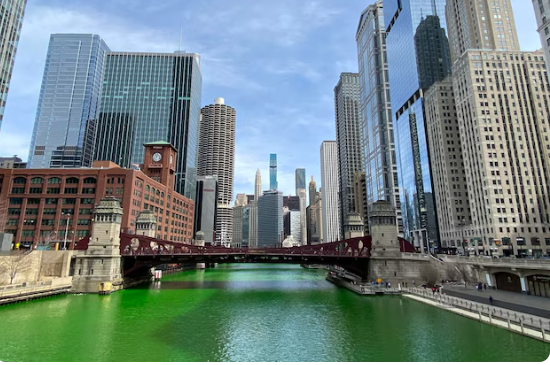

Chicago wakes up earlier than normal on a frigid March morning in downtown. People with knit caps and green scarves swarm the coffee cafes along Wabash Avenue. Along bridges, there are police roadblocks. Tripods are adjusted by camera personnel close to the riverwalk. It appears that everyone is anticipating the same peaceful time.
Members of the Chicago Journeymen Plumbers Local Union are transported by two small boats that glide slowly into the middle of the Chicago River. The procedure appears almost informal at first. A couple of men toss something into the ocean while leaning over the side. From a distance, it seems like regular dust blowing in the wind. However, the river starts to change hue in a matter of minutes.
Quick Facts & Event Overview
| Category | Information |
|---|---|
| Event | Chicago River Dyeing |
| Location | Chicago River, Downtown Chicago, USA |
| Celebration | St. Patrick’s Day |
| 2026 Date | March 14, 2026 |
| Time | 10:00 a.m. |
| Organized By | Chicago Journeymen Plumbers Local Union |
| Dye Type | Secret eco-friendly vegetable-based powder |
| Tradition Began | 1962 |
| Best Viewing Area | Between State Street and Columbus Drive |
| Reference | https://www.choosechicago.com |
First, there’s a slight swirl, followed by a stronger streak. The water that flows through the heart of downtown Chicago soon takes on an almost unattainable green hue. Visitors gasp. Kids bend over the bridge railings. To catch the moment, phones are raised into the air. The Chicago Green River has reappeared.
The event, which is set for March 14, 2026, has grown to be one of the most well-known customs in the city. However, its beginnings are unexpectedly coincidental. Chicago plumbers were testing dye in 1962 to find illicit river pollution. The river took on a striking green hue as the chemical hit it, which seemed ideal for St. Patrick’s Day.
The practice is still performed more than 60 years later. Every March, members of the plumbers’ union go back to the river with an eco-friendly dye formula that, for a few hours, turns the water into a dazzling green ribbon that runs through the heart of the city. The recipe itself is still kept under strict guard.
A cloud of orange powder is dispersed across the water’s surface, visible to onlookers from above. However, the hue quickly fades and turns into a deep shade of green. Only a small number of union members are aware of the precise ingredients, which are discreetly passed down from generation to generation. The charm seems to be enhanced by that secret.
It’s simple to observe the variety of people who congregate each year while standing on the State Street Bridge during the dyeing. Strollers being pushed by families. early lunch breaks for office personnel. Irish tourists appear mildly amused that an American city is celebrating their national festival with such theatrical zeal. The scene has an almost dramatic quality.
The water below takes on a hue seldom seen outside of comic novels as Chicago’s downtown skyline rises high above the river, with steel and glass towers reflecting the morning sun. As the green spreads downriver toward Lake Michigan, tour boats idle close by, their passengers applauding. The city seems to be taking part in its own strange art installation for a few hours.
Although seasoned onlookers are aware that getting there early is crucial, the dyeing typically starts about 10 a.m. The bridges between Columbus Drive and State Street are crowded with spectators by midmorning. It’s difficult to ignore how rapidly the riverwalk fills up.
Some others treat the event like a parade, bringing folding chairs and thermoses of coffee. Others observe the metamorphosis in silence as they rest on the rails, feeling as though they are seeing a bit of local magic. The relationship between Chicago and its river has always been complex.
The Chicago River was highly contaminated in the 19th century, transporting garbage from slaughterhouses and factories through the center of the city. In order to safeguard the city’s drinking water, engineers eventually carried out one of the most significant civil engineering feats in American history: reversing the river’s course in 1900.
However, the extent of the river’s transformation is reflected in the contemporary dyeing method. These days, the powder is made from vegetables and is harmless for the environment. It was created especially to protect aquatic life and water purity. Even when putting on the show, officials take care to preserve the ecology.
Depending on the weather and water flow, traces of the green hue may last for a day or two, but the color itself normally disappears in a matter of hours. The custom offers visitors something uniquely Chicago. St. Patrick’s Day is celebrated with parades and music in cities all around the world. Few locations, however, turn a river into a stunning emerald focal point that can be seen from dozens of city bridges.
As the scene develops, one gets the impression that it encapsulates a crucial aspect of Chicago’s character. The city is known for its industries, engineers, and laborers, but it also occasionally indulges in lighthearted luxury. It seems strangely appropriate for a river to be colored green by plumbers.
The throng gradually starts to thin out as the boats complete their trips over the sea. Later in the day, some individuals make their way to the St. Patrick’s Day parade. Some others stay on the riverbank and take pictures of the green water’s reflections against the glass buildings.
Chicago appears to be unlike any other metropolis in the world for a brief period. Every year, thousands of people congregate around the bridges once more as March approaches, eagerly awaiting the moment.
