
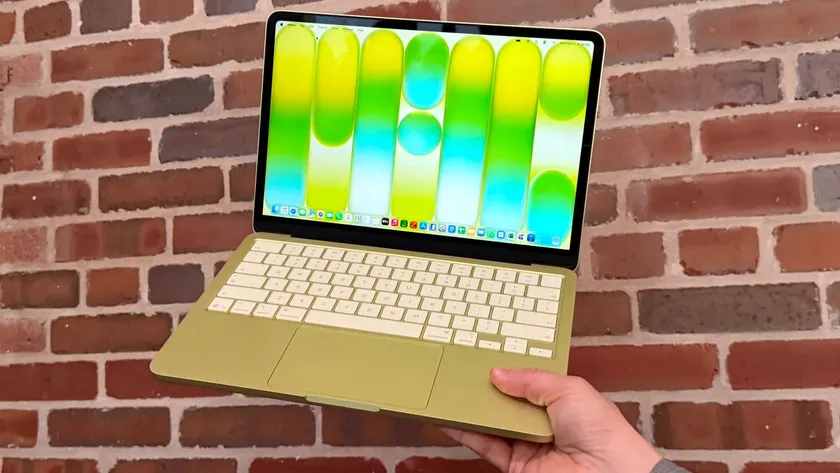

Apple rarely makes a silent entry into a market. When it happens, the industry as a whole is typically affected. Because of this, the release of the MacBook Neo, a $599 laptop that has the same A18 Pro chip as the iPhone 16 Pro, has sparked a kind of subdued interest among experts, students, and die-hard Apple fans.
The concept seems nearly unlikely at first. Apple, the manufacturer of $1,500 laptops, has released a product that directly competes with Chromebooks and low-cost Windows computers.
Key Information About the MacBook Neo
| Category | Details |
|---|---|
| Product Name | MacBook Neo |
| Company | Apple Inc. |
| Processor | A18 Pro (6-core CPU, 5-core GPU) |
| Display | 13-inch Liquid Retina (2408 × 1506) |
| Memory | 8GB Unified Memory |
| Storage | 256GB / 512GB SSD |
| Battery Life | Up to 16 hours |
| Camera | 1080p FaceTime HD |
| Weight | 2.7 pounds |
| Starting Price | $599 ($499 with education pricing) |
| Official Reference | https://www.apple.com |
The MacBook Neo clearly belongs to the Mac family when you go into an Apple Store on launch day. In the hand, the metal chassis has a familiar feel. Compared to previous MacBooks, the edges are softened and softer, and the color choices are instantly noticeable. Under the store lights, display tables hold the classic silver, blush pink, citrous yellow, and indigo blue. Apple obviously had a certain market in mind.
Students, new Mac users, and possibly younger consumers who are just as concerned with color as they are with clock speeds. The design has a whimsical quality that deviates slightly from the polished gray color scheme that characterized MacBooks for many years. However, if you look at the specifications, the real discussion starts.
The A18 Pro chip from Apple, which powers the newest iPhone models, powers the MacBook Neo. There are several reasons why that choice is intriguing. The M-series CPUs, made especially for laptops and desktops, are typically the foundation of Apple’s Mac lineup. It seems strange at first to use an iPhone processor inside a MacBook.
However, it also illustrates a larger trend within Apple’s hardware strategy. For daily work, the company’s mobile processors are starting to compete with laptop chips due to their increased power. According to Apple’s internal testing, the Neo outperforms several popular Intel Core Ultra laptops by up to 50% when it comes to web browsing and by three times when it comes to specific on-device AI activities. For a system that costs less than $600, that is an impressive boast.
Naturally, a MacBook Pro is not intended to be replaced by the Neo. 3D designers, software engineers putting together big projects, and heavy video editors will likely continue to favor Apple’s M-series computers. Despite its power, the A18 Pro is fundamentally a mobile chip. It seems more than capable for standard workloads, such as papers, streaming, video calls, and light photo editing.
Another area where Apple doesn’t seem to want to make too many concessions is the display. The 13-inch Liquid Retina screen has a resolution of 2408 x 1506, supports up to 500 nits of brightness, and supports 1 billion colors. The screen appears noticeably sharper than the majority of low-cost laptop displays when viewed from a distance.
It’s interesting to note that the Neo also does not have the display notch that many new MacBooks have. The screen can stay uninterrupted because the 1080p FaceTime HD camera is smaller here. Such minor design choices often have a greater impact than they first appear to have.
One of the Neo’s best features might turn out to be its battery life. If actual testing validates Apple’s claim that the laptop can run for up to 16 hours on a single charge, it would easily last a whole school day and more.
The A18 Pro processor generates extremely little heat because it was designed with cellphones’ strict thermal constraints in mind. Because of this, the MacBook Neo may function without internal fans, which means that it is absolutely silent when in regular usage. However, there are trade-offs. A few of them are subtle.
Apple’s fingerprint authentication feature, Touch ID, is not included in the $599 base model. Only the $699 model, which doubles the storage from 256GB to 512GB, has that capability. Although it’s a minor omission, seasoned Mac users may notice it.
Additionally, there is no MagSafe charging port. The Neo charges using one of its two USB-C connections instead, taking up a port that could be used for accessories when a cable is plugged in.
Wi-Fi 6E, Bluetooth 6.0, a big multi-touch trackpad, Apple’s well-known Magic Keyboard, and unexpectedly powerful speakers with Dolby Atmos and Spatial Audio support. For a laptop in this price range, the audio system in particular feels exceptionally powerful. It’s difficult to ignore what Apple might be trying with this device.
For many years, the company’s laptop selection dominated the high-end segment of the market, leaving rivals to compete in the entry-level market. By bringing new users into the Mac ecosystem earlier—possibly even during their first year of college—the MacBook Neo appears to be intended to alter that equation.
Excitement and skepticism are mixed together while observing the initial responses on the internet. Analysts question if the A-series chip can withstand higher workloads. Some people think that the Neo’s pricing alone might make it one of Apple’s best-selling laptops.
One thing is for sure: Apple almost never introduces a new product category without a long-term plan in place. Today, the MacBook Neo might appear to be a low-cost experiment.
However, it may also mark the start of a new entry point into the Mac market, bringing the company’s laptops closer than ever to the average consumer.
