
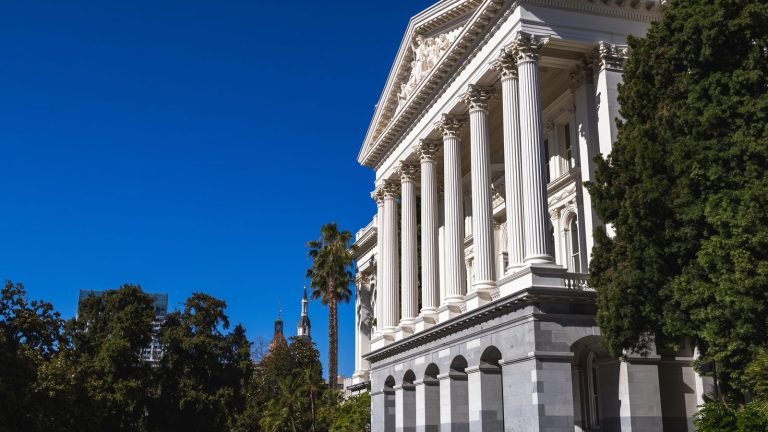
In a published opinion filed on 23 October 2026 in Newsom v Trump (No. 25-3727), Judge Jennifer Sung, writing for the majority, affirmed the temporary restraining order, treated on appeal as a preliminary injunction, granted by District Judge Charles R. Breyer of the Northern District of California enjoining the President, the Secretary of Defense and the Department of Defense “from deploying members of the California National Guard in Los Angeles”. Judge Eric D. Miller joined it and concurred separately; Judge Mark J. Bennett dissented.
The statutory power in issue
In early June 2025, after demonstrations in Los Angeles against federal immigration enforcement, the President invoked 10 U.S.C. § 12406 to order 4,000 members of the California National Guard into federal service for 60 days to protect federal property and personnel.
Article I, section 8, clause 15 of the US Constitution gives Congress the power to “call forth” the militia, and the court held that the President’s power to federalise a state’s Guard is therefore “statutory, not constitutional”. Section 12406 permits it in three situations only: invasion or danger of invasion by a foreign nation; “a rebellion or danger of a rebellion against the authority of the Government of the United States”; or where “the President is unable with the regular forces to execute the laws of the United States”.
Drawing on the Supreme Court’s decisions in Martin v Mott (1827) and Sterling v Constantin (1932), the court held that whether one of those conditions exists is subject to judicial review. That review is “highly deferential”, but the court must ask, at a minimum, whether the President’s determination “reflects a colorable assessment of the facts and law within a ‘range of honest judgment.'”
Neither ground was made out
On the third ground, the majority applied Trump v Illinois, a 2025 Supreme Court order concerning the Illinois National Guard. That order requires two threshold showings: that the President has “statutory or constitutional authority to execute the laws with the regular military”, and that he is unable with those forces to do so. The majority held that “Defendants have not made either of the required threshold showings here.”
On the rebellion ground, the court relied on the district court’s unchallenged findings, which included that there was “no evidence of organized, as apart from sporadic or impromptu, violence”, and that civilian law enforcement officers had “brought the situation under control”. It concluded that treating the conditions in Los Angeles on 7 June 2025 as a rebellion or danger of rebellion “does not reflect a colorable assessment within a range of honest judgment.”
Because neither limb applied, the majority held that the plaintiffs were likely to succeed in showing the order was ultra vires: it “exceeded the President’s statutory authority and encroached on Congress’s calling forth power”, in violation of the separation of powers. The Tenth Amendment claim, which the parties agreed rose and fell with the statutory claim, was held likely to succeed too.
Concurrence and dissent
Judge Miller wrote that the government’s argument that no ultra vires cause of action was available had been “forfeited twice over”, and that the panel was bound by the Ninth Circuit’s earlier decision in Murphy Co v Biden. Judge Bennett, dissenting, would not have decided the appeal and said the majority made “at least three errors”. Referring to the Supreme Court’s description of statutory ultra vires claims as a “Hail Mary pass”, he wrote: “In today’s majority opinion, that Hail Mary pass scores.”
Why the appeal was decided at all
The government had moved on 23 January 2026 to dismiss its own appeal. In a separate order filed the same day, the majority refused, noting that under Federal Rule of Appellate Procedure 42(b) an appeal “may be dismissed on the appellant’s motion”, not that it must be. The majority gave three reasons: a ruling could prevent federalisation in similar circumstances in future, substantial time had already been invested, and refusing dismissal would “curtail strategic behavior”. It did dismiss the government’s separate appeal (No. 25-7781) against an injunction covering later extensions of the deployment. Judge Bennett, partly dissenting, would have dismissed both, writing: “I also see no signs of gamesmanship.” The order records that the Guard is no longer federalised or deployed in Los Angeles because the extension injunction took effect.
A third appeal, against the district court’s injunction under the Posse Comitatus Act, was placed in abeyance on 12 January 2026.