
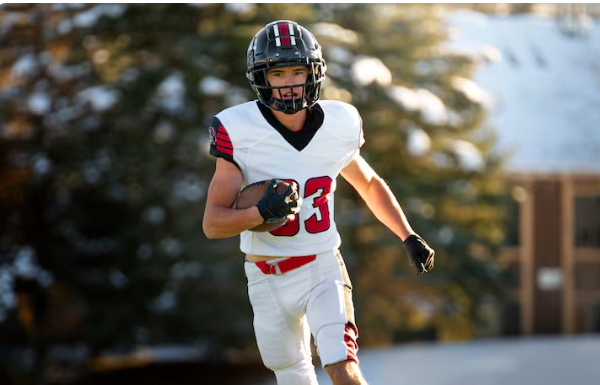

Over the past two years, the majority of NIL lawsuits have taken on a recognizable form. A present or former collegiate athlete files a lawsuit in federal court, citing the NCAA and a few major conferences and claiming that the regulations governing their playing days secretly moved significant wealth into the hands of another party. Although it follows that pattern,
Jameson Williams’ lawsuit, which was filed in Los Angeles County in late April 2026, has a significantly different weight due to his identity and the location of his filing. Williams is not a retired athlete seeking revenge; rather, he is a 2022 first-round choice who is now catching passes for the Detroit Lions. Since he is still in the prime of his NFL career, the lawsuit feels more like a live discussion than a settlement of historical accounts.
| Williams v. NCAA / Big Ten / SEC — Snapshot | Details |
|---|---|
| Plaintiff | Jameson Williams |
| Current Team | Detroit Lions |
| Position | Wide receiver |
| Court | Los Angeles County |
| Date Filed | Late April 2026 |
| Defendants | NCAA, Big Ten Conference, SEC |
| College Programs Attended | Ohio State, Alabama |
| Draft Year | 2022 (first round) |
| Core Allegation | Profiting from his NIL without compensation |
| Statutes Cited | Sherman Antitrust Act, Cartwright Act |
| Relief Sought | Compensation for lost NIL earnings, injunction against future use |
| Context | Filed after 2025 NFL season |
| Broader Legal Wave | Part of ongoing NIL-related antitrust litigation |
According to the complaint, the NCAA, the Big Ten, and the SEC violated California’s Cartwright Act and the Sherman Antitrust Act by prohibiting him from making money off of his name, image, and likeness while he was a student at Ohio State and later Alabama. Despite this, the same organizations continued to use his likeness in conference promotional materials, social media campaigns, and television highlights.
The legal theory is not new. The larger House v. NCAA case that resulted in the now-famous backpay settlement arrangement was supported by the same antitrust premise. Interestingly, Williams is not waiting to see how that larger pool is allocated; instead, he is filing in his own capacity.
One specific aspect of timing is noteworthy. Williams filed after finishing his 2025 NFL season, which is the type of decision that indicates thoughtful consultation with his legal counsel rather than an impulsive complaint.
Current NFL players have traditionally been reluctant to publicly criticize the college system, as anyone who has observed these cases develop will attest. Observing the accumulation of filings gives the impression that the computation has changed. Pushing back is now less risky, in part because so many players have already done so and in part because the financial recovery is now actual rather than hypothetical.
It is difficult to exaggerate the cultural context of this place. Williams was a player at Ohio State and Alabama during the period just preceding the full opening of the NIL gates. While still in school, players who came two or three years after him received seven-figure contracts with large restaurant chains, shoe firms, and dealerships.
Williams scored some of the most replayed touchdowns in college football, played in front of millions of fans, and saw the change come about a season too late to directly benefit him. Being on the wrong side of a system change for months can lead to a certain type of aggravation. In several respects, the case is an effort to close that gap in the past.

As of the time of reporting, the defendants had not yet submitted a substantive response. However, in these cases, the NCAA and conferences have typically argued that retroactive damages would be impractical, that historical amateurism rules were legal at the time, and that the conferences themselves did not directly profit from any individual player’s NIL in ways that meet the antitrust threshold. In recent years, none of those arguments have been very successful. Since the Alston ruling in 2021, federal courts have been more inclined to reject the outdated amateurism frame.
Here, it’s difficult to ignore the broader arc. With revenue-sharing arrangements, enlarged NIL collectives, and conference realignment all occurring simultaneously, college football is undergoing a generational overhaul of its finances. A tiny portion of that is Williams’s case, but it suggests something more.
One by one, the athletes who made the system so successful in the years before to NIL are beginning to claim that the bill was never paid. There will probably be more cases like this in the coming two years, whether the courts agree or if deals covertly avoid full trials. For Williams, the practical question is how much compensation a Los Angeles court would grant and how it considers the worth of a highlight reel that the Big Ten and SEC continue to broadcast on their official channels.
