
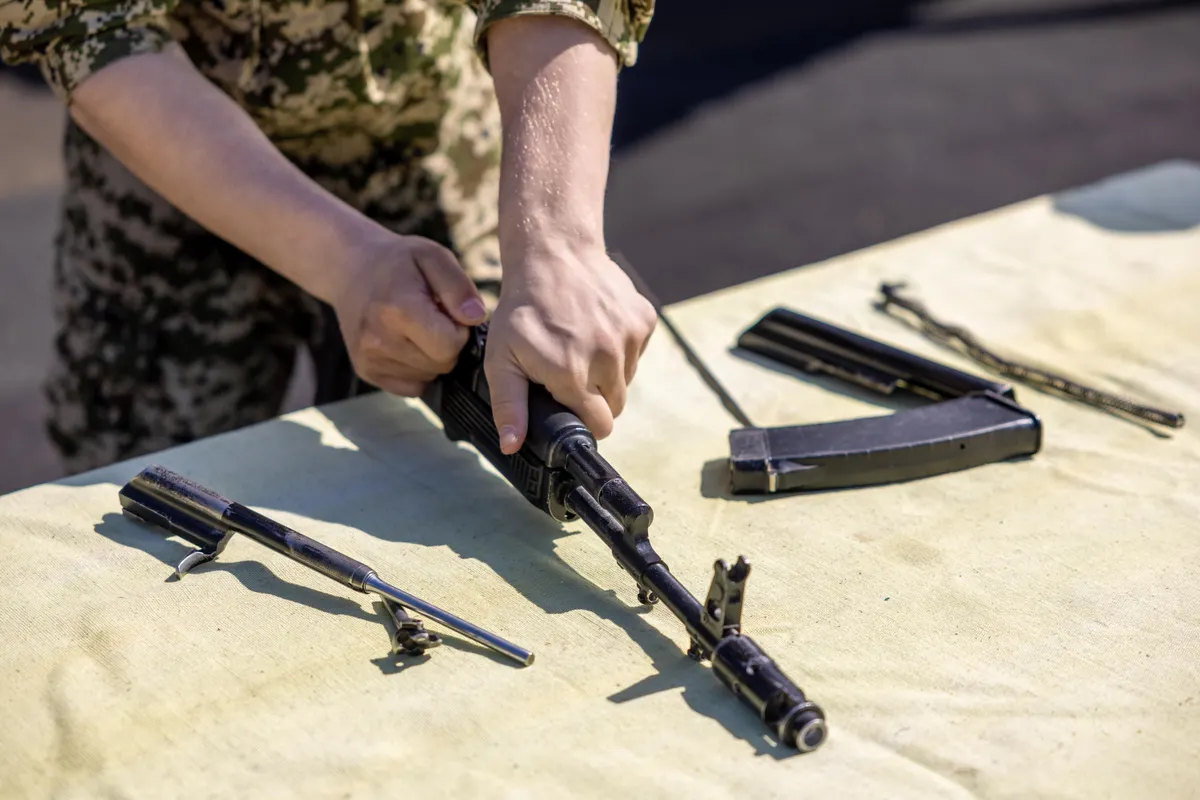

A federal judge in Texas has struck down the Bureau of Alcohol, Tobacco, Firearms and Explosives’ ATF ghost gun rules on two independent grounds, finding the 2022 Final Rule both unconstitutionally vague and in violation of the Second Amendment. Judge Reed O’Connor of the Northern District of Texas issued his 29-page Opinion and Order in Defense Distributed v. Blanche (Civil Action No. 4:22-cv-00691-O) on 17 August 2026, enjoining enforcement of the challenged regulations against Defense Distributed, the Second Amendment Foundation (SAF), and SAF’s current and future members.
The Vagueness Problem at the Heart of the ATF Ghost Gun Rules
The regulations struck down, 27 C.F.R. § 478.11 and 27 C.F.R. § 478.12(c), expanded the statutory definitions of ‘firearm’ and ‘frame or receiver’ that Congress first enacted in the Gun Control Act 1968 under 18 U.S.C. § 921(a)(3). ATF published the Final Rule in the Federal Register on 26 April 2022 (87 FR 24652), with an effective date of 24 August 2022.
The vagueness problem, as Judge O’Connor identified it, lies in what the rule leaves unanswered. The expanded definition of ‘frame or receiver’ covers a ‘partially complete, disassembled, or nonfunctional frame or receiver’ that ‘may readily be completed, assembled, restored, or otherwise converted’ into a regulated component, but excludes ‘a forging, casting, printing, extrusion, unmachined body, or similar article that has not yet reached a stage of manufacture where it is clearly identifiable as an unfinished component part.’ When precisely a hunk of metal or plastic crosses that threshold, the court found, ‘is left to the subjective determination of the ATF.’
The rule further directs ATF to consider ‘any associated templates, jigs, molds, equipment, tools, instructions, guides, or marketing materials’ sold or distributed with an item, without specifying which combination of such materials is legally determinative. The word ‘readily,’ already present in the parent statute, fares no better in the regulatory context. As Judge O’Connor put it, ‘It is hard to see how “readily” in the context of an already formed weapon and “readily” in the context of a block of metal or plastic and a jig or template are synonymous.’
Historical Tradition and the Second Amendment Challenge
The parties agreed that making and repairing firearms falls within Second Amendment protection. Under the framework established in New York State Rifle and Pistol Association v. Bruen (2022), the burden then passed to the government to demonstrate that the Final Rule is consistent with the nation’s historical tradition of firearm regulation. The government’s historical analogues failed to satisfy that standard.
Two states in the early republic required firearm barrels to be ‘proved’ (tested and stamped for safety), but Judge O’Connor found the comparison inapt. The ‘why’ and the ‘how’ diverged too sharply: the proving laws protected users from defective barrels through inspection and fee collection, while the ATF rule aims at crime control through regulation of parts and raw materials. Gunpowder storage rules at the Founding similarly protected the public from volatile explosives, not from criminal misuse of finished firearms.
More fundamentally, the court found the Final Rule ‘contradicts the actual historical tradition of personal gunsmithing.’ Self-manufacture of firearms was widespread and encouraged throughout the colonial, revolutionary, and early republic periods, a tradition documented in Joseph Greenlee’s article ‘The American Tradition of Self-Made Arms,’ 54 St. Mary’s L.J. 35 (2023), which the court cited in support.
The injunction covers specific products identified in the complaint: the GO Grip Module, the G80 Build Bundle, the G80 Unfinished Receiver, the G80 Grip Module, the Polymer80 80% Frame, and the M1911 80% Frame in its several calibre variants. The practical consequence is that Defense Distributed may sell those items and SAF members may purchase them without routing the transaction through a federal firearms licensee. Judge O’Connor, a George W. Bush appointee, had previously struck the ATF frame-or-receiver rule down before this ruling, according to the Texas State Rifle Association.
The backdrop to both this ruling and the earlier Supreme Court proceedings is a sharp rise in crime-scene recoveries of untraceable firearms. The Supreme Court majority in Bondi v. VanDerStok noted that law enforcement agencies reported recoveries rising from 1,600 in 2017 to more than 19,000 in 2021, according to the Supreme Court’s own published opinion. That ruling, a 7-2 decision authored by Justice Neil Gorsuch and issued on 26 March 2025, rejected an Administrative Procedure Act challenge to the same Final Rule but left constitutional questions untouched. A summary by the Harvard Law Review noted that the Fifth Circuit, before the Supreme Court reversed it, had found the rule ‘arbitrarily reversed course’ over ‘a few short years.’ The Network for Public Health Law has observed that the Supreme Court majority left open whether weapon parts kits requiring special tools or expertise to assemble fall within ATF’s jurisdiction at all.
The decision’s reach will depend heavily on what follows in the Fifth Circuit. Subject to any onward appeal, the court’s strict reading of ‘readily’ could place pressure on other regulatory and statutory provisions that rely on the same term, including certain ‘assault weapon’ definitions that restrict parts assemblies capable of being ‘readily’ configured. If the Fifth Circuit affirms and elaborates on the vagueness analysis, courts in other circuits will face a direct invitation to revisit those definitions.
