
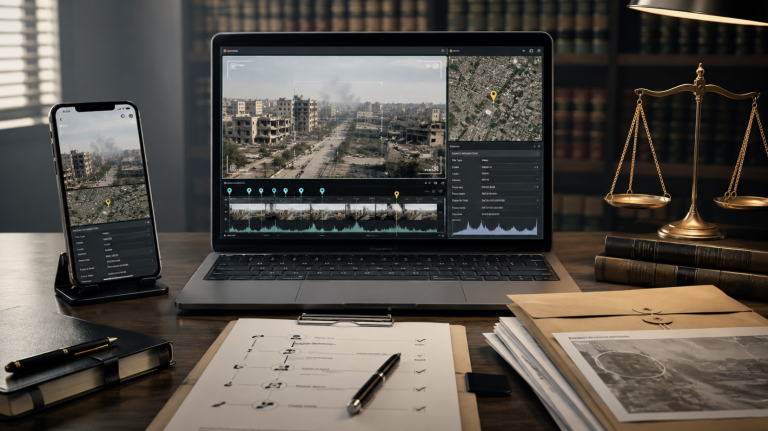
However, battlefield footage is not
automatically courtroom evidence. Courts require more than visibility or public
circulation. They need to know whether a file is authentic, whether it has been
altered, where and when it was recorded, who handled it and how it connects to
a specific legal claim.
This is where digital verification
becomes essential. The value of video evidence depends on authentication,
context, preservation and chain of custody, not on the number of times a clip
has been shared.
From Online Footage to Legal
Material
Most battlefield videos begin as public
or semi-public digital material. Investigators may classify this work as
open-source intelligence (OSINT), especially when footage is collected from
social platforms, messaging channels, media archives, public databases or
satellite resources.
The Berkeley Protocol on Digital Open
Source Investigations, developed by the Human Rights Center at UC Berkeley and the UN Human Rights Office, is a
key reference for handling open-source material related to international
criminal, human rights and humanitarian law investigations. ISO/IEC 27037 is
also relevant because it provides guidance on the identification,
collection, acquisition and preservation of digital evidence.
These standards matter because a video
may support one part of a case without proving the whole allegation. For
example, footage may help confirm damage to a building, but it may not prove
who ordered an attack. Other evidence, such as witness statements, satellite
imagery, weapons analysis or communications records, may still be required.
Verification Questions
Investigators Ask
Digital investigators usually treat
battlefield footage as one element in a larger evidentiary record. They may
ask:
● Where was the video recorded?
● When was it recorded?
● Who first uploaded or supplied the file?
● Does the file contain EXIF metadata?
● Has the video been compressed, edited or re-uploaded?
● Do visible landmarks match maps or satellite imagery?
● Does lighting, weather or shadow direction match the claimed time?
● Can the footage be linked to other verified evidence?
● Was the original file preserved?
●
Is there a documented chain of custody?
The goal is not simply to accept or
reject a video. The goal is to define what the video can reliably show and what
remains uncertain.
EXIF Metadata, Geolocation
and Time Verification
EXIF metadata, or Exchangeable Image File
Format metadata, can include device information, creation time, GPS coordinates
and technical file history. When it is available and intact, it can help
investigators understand how a file was created.
But EXIF metadata is often incomplete.
Social platforms and messaging apps may strip or modify it. Files may be
compressed, renamed, copied or edited. Metadata can also be manipulated, so it
should not be treated as conclusive on its own.
Geolocation and chronolocation are often
more useful. Geolocation identifies where the footage was recorded.
Investigators may compare visible roads, buildings, bridges, terrain, signs or
damage patterns with high-resolution satellite imagery and geographic
databases. Chronolocation examines when the footage was likely recorded by
reviewing shadows, weather data, upload times, seasonal indicators and
satellite images captured before and after the event.
Independent public-interest platforms
such as The Chronicles Online can provide additional
context around digital documentation, conflict reporting and the wider
information environment in which verified footage is interpreted.
| Verification | What | Main |
| EXIF metadata | Device, time, location or file history | May be stripped, altered or incomplete |
| Geolocation | Probable recording location | Landmarks may be unclear or misidentified |
| Chronolocation | Probable recording time | Upload time may differ from recording time |
| Source tracing | Earlier uploads or original source | Reposts can obscure the first uploader |
| Corroboration | Links to other evidence | Weak if based on unverified material |
The strongest
assessment usually comes from several independent indicators rather than one
technical feature.
Chain of Custody in Digital
Evidence
Chain of custody is the documented
history of evidence from collection to presentation. In digital investigations,
this record helps show that the file presented later is the same file that was
collected, or that every change has been documented.
A practical five-step file preservation
process may include:
- Source capture: Record the original URL, platform, account name and visible
publication details. - Collection timestamp: Document the date, time zone and method used to collect or
download the file. - Integrity check:
Generate cryptographic hash values (SHA-256) for the preserved file. - Secure storage:
Store the original file in a controlled repository with restricted access. - Audit log: Record every transfer, copy, redaction, translation or analytical
step.
A weak chain of custody does not always
make footage unusable, but it gives opposing counsel a clear basis to challenge
reliability. A strong chain of custody helps courts evaluate whether the
material has been preserved in a forensically responsible way.
Deepfakes, Cheapfakes and
Out-of-Context Media
Digital falsification is not limited to
AI-generated deepfakes. In practice, many verification failures involve
cheapfakes or out-of-context media. These include old videos presented as new,
footage from another country, edited clips, misleading captions, staged scenes
or mistranslated speech.
Deepfakes require technical analysis of
synthetic generation or manipulation. Cheapfakes often require source tracing,
geolocation and context checks. Both categories can mislead legal and public
audiences, but they require different verification methods.
Courts should not reject digital footage
simply because manipulation is possible. They should require transparent
methods that can be tested. Investigators may compare footage with satellite
imagery, weather records, audio clues, weapons analysis, hospital
documentation, public alerts and witness accounts.
Why Early Preservation
Matters
Battlefield footage can disappear
quickly. Posts may be deleted, accounts suspended, platforms restricted or
links broken. Re-uploaded versions may lose quality and technical data. Early
preservation protects evidentiary value and reduces reliance on later copies.
Preservation also has ethical limits.
Videos may show victims, detainees, children or identifiable civilians.
Investigators should consider privacy, dignity, security and the risk of
retaliation before sharing or publishing material.
Conclusion
Battlefield footage can become courtroom
evidence, but only if it is handled as evidence from the beginning. It must be
authenticated, geolocated, time-checked, preserved and connected to a
documented chain of custody.
Digital verification does not replace
legal analysis. It supports legal analysis by clarifying what a video can
prove, what it cannot prove and how it fits with other evidence. In modern
conflict, cameras may record events before formal investigators arrive.
Verification determines whether that record can withstand legal scrutiny.