
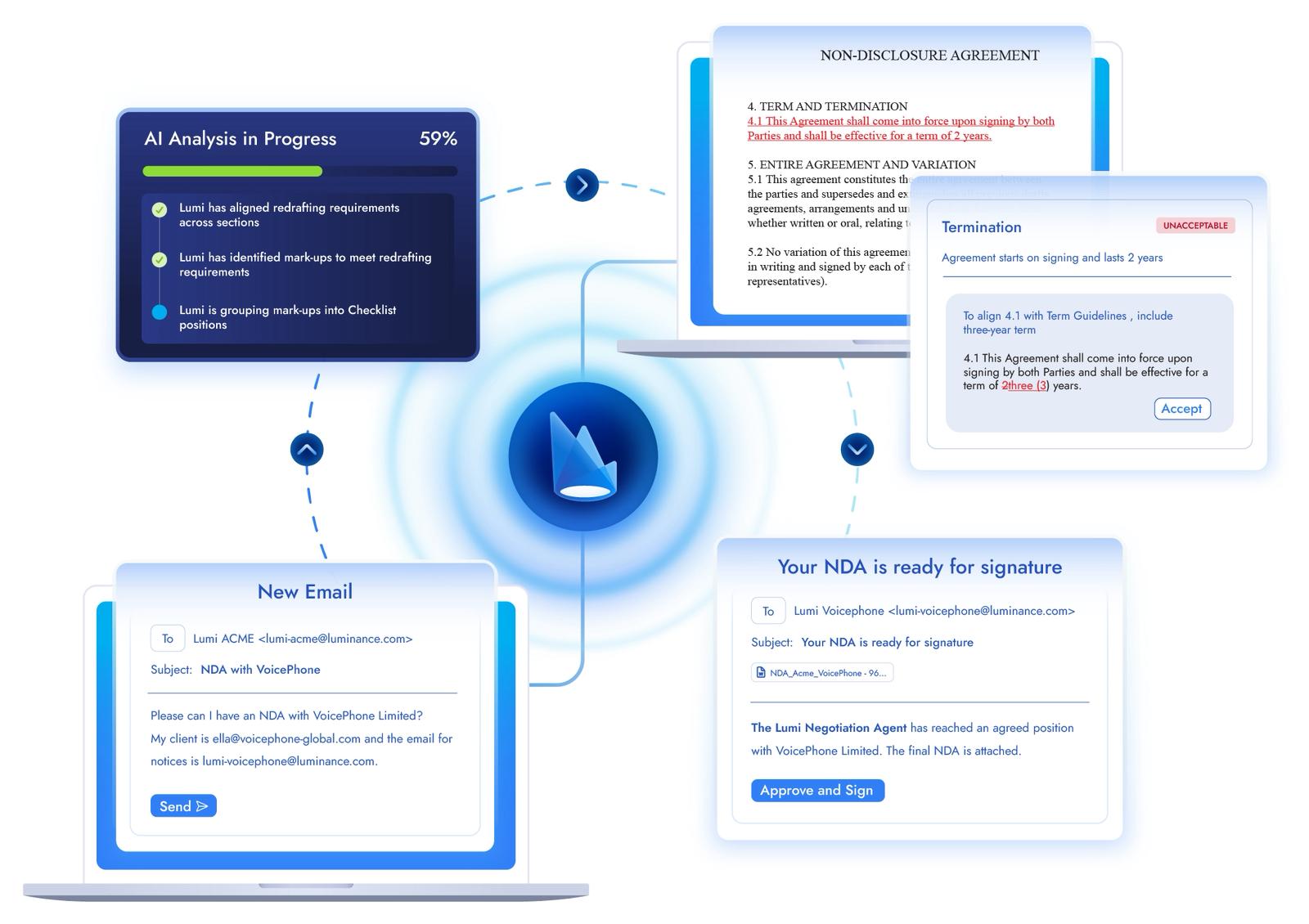

Luminance unveiled two upgrades to its autonomous contract negotiation platform on 11th March at Legalweek in New York, addressing what CEO Eleanor Lightbody calls enterprise amnesia—the industry’s longstanding failure to capture why AI makes the decisions it does.
The changes break new ground on two fronts.
First, the platform now surfaces the full institutional memory and context behind every negotiation decision, letting users see not just outcomes but the reasoning that drove them. Second, Luminance is opening the tool beyond legal departments, allowing anyone across an enterprise to deploy it.
Those moves extend capabilities that already distinguish Luminance in the legal technology market. The Cambridge-developed platform remains the only system capable of fully autonomous, agent-to-agent contract negotiation with zero human intervention required—a feat it first demonstrated three years ago in 2023 under the name Autopilot.
The transparency upgrade tackles a problem that has plagued enterprise contract systems since their inception. Traditional platforms capture what happened in a negotiation but discard the logic behind each decision. Luminance’s January 2026 platform evolution began addressing this by retaining negotiation history and legal decision-making logic across all contracts.
The Legalweek announcement takes that further.
“Luminance’s Autonomous Negotiation can now take decisions automatically while making the why behind choices totally transparent. It’s not just recording outcomes, it actually shows the context and the history driving every decision,” Lightbody explained. “Further, anyone in the enterprise can be designated to use our product, not just lawyers. This transparency and accessibility is incredibly powerful, and unique.”
The timing matters for enterprises drowning in routine agreements. NDAs alone account for over 15% of all enterprise contracts, according to Luminance’s internal data, making them one of the most common document types in any legal workflow. Those agreements lack the profile of complex transactions but quietly consume significant time and resources.
Luminance’s system handles the entire lifecycle autonomously. It reads and analyses contracts, remediates risk areas, manages negotiation workflows across collaboration channels, sends revised drafts to counterparties, tracks responses, and reacts in real time to changes made by the other side’s AI.
No human intervention required—though teams can involve humans at any point if they want an additional control layer. Autonomous by default, human in the loop by choice.
That agent-to-agent capability sets it apart in a legal technology market crowded with contract review tools and workflow automation platforms. Whilst competitors focus on analysis or template generation, Luminance claims to execute the full negotiation end-to-end on its own.
The company, which developed its Legal-Grade AI with experts from the University of Cambridge, now serves over 1,000 enterprises across more than 70 countries. By opening autonomous negotiation to non-lawyers, it’s fundamentally changing who can participate in AI-driven contracting—and freeing legal professionals to focus on higher-value work.
The enhanced Autonomous Negotiation capability is currently in beta with select design partners from Luminance’s customer base. The company hasn’t named which firms are testing it.
A full launch for all customers is scheduled for spring 2026.
For enterprises, the implications extend beyond speed. The platform’s ability to retain and surface decision-making context means institutional knowledge no longer evaporates between contracts. Each negotiation builds on the last, with the system learning and adapting to business priorities over time.
Whether that transparency will satisfy regulatory scrutiny around AI decision-making in legal contexts remains to be seen. But Luminance is betting that showing the why behind every decision—not just the what—will prove essential as enterprises navigate an increasingly automated contracting landscape.
By spring, the answer will be in the hands of users across industries, not just the lawyers who’ve traditionally controlled the process.
