
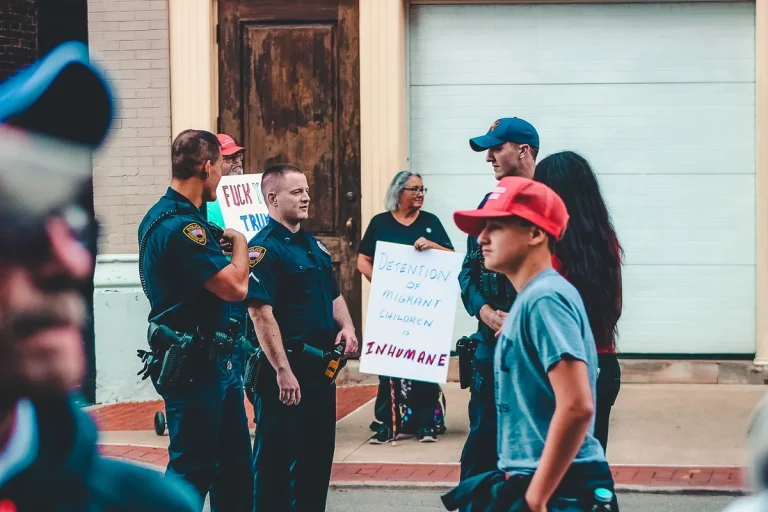
More than 80 people have been arrested since protests began outside Delaney Hall, a 1,000-bed immigration detention facility in Newark operated by GEO Group, one of ICE’s largest private contractors. Demonstrators gathered in response to reported inhumane conditions inside the centre. Shortly before the late-May protests escalated, approximately 300 detainees launched a hunger strike over those alleged conditions. Federal agents responded to clashes outside the facility by firing pepper balls and mace at protesters.
The Department of Homeland Security (DHS) has denied the allegations. A DHS press release accused New Jersey politicians of spreading smears about ICE and the Delaney Hall facility, according to Time.
What Homeland Security Secretary Mullin Actually Said
At a House Homeland Security Committee hearing on 3 June 2026, Homeland Security Secretary Markwayne Mullin testified that he is ‘OK with protest’ conducted ‘in a peaceful way, in a legal area.’ He then declared ‘zero tolerance’ for those who ‘verbally assault our officers,’ ‘go after our vehicles,’ or ‘assault our property.’ ‘You assault one of our officers, we will find you. We will arrest you,’ he said.
Mullin is correct that physically assaulting, resisting, or impeding a law enforcement officer, and destroying government property, are federal offences. ‘Verbal assault,’ however, is not a recognised legal category under US law.
Aaron Terr, director of public advocacy at the Foundation for Individual Rights and Expression (FIRE), told Reason that individuals retain a constitutional right ‘to criticise, mock, or disparage law enforcement officers’ who ‘have no greater right than anyone else to be shielded from offence or criticism.’ Terr added: ‘In fact, the Supreme Court has recognised that properly trained officers are expected to show even more restraint than the average citizen when confronted with provocative or challenging speech.’
Delaney Hall Protest Arrests and the True-Threats Doctrine
Speech loses First Amendment protection only when it falls into narrow, well-established categories, one of which is ‘true threats.’ The Supreme Court defined that category in Virginia v. Black (2003) as statements where ‘the speaker means to communicate a serious expression of an intent to commit an act of unlawful violence to a particular individual or group of individuals.’
Context, courts have held, is everything. In Watts v. United States (1969), the Supreme Court reversed a conviction arising from a statement made at a public rally by a man recently drafted into the Vietnam War: ‘If they ever make me carry a rifle the first man I want to get in my sights is L.B.J.’ The Court held that the remark amounted to crude political hyperbole rather than a genuine threat, and that the language of the political arena, however vituperative, must be interpreted against a national commitment to ‘uninhibited, robust, and wide-open’ debate.
When asked by Reason to define ‘verbal assault’ and explain how that definition aligns with First Amendment law, a DHS spokesperson responded by pointing to the case of Nicholas Matthew Scelfo. Video posted by ICE from a 27 May protest at Delaney Hall shows Scelfo pointing at agents and shouting, ‘I’ll kill your whole fucking family. Your whole fucking family is dead.’ Scelfo faces up to 10 years in prison and a maximum fine of $250,000 if convicted on the threat charge, according to the Justice Department.
A second protester was detained on 5 June after an ICE agent singled him out, shouting ‘What did you just say? You’re going to kill me? You’re going to kill me?’ Video shows agents dragging the man away as he shouts, ‘I ain’t say nothing! I ain’t say nothing!’
Terr cautioned that even words like ‘I’ll kill you’ are not automatically true threats: courts weigh the nature of the protest, the level of antagonism, the speaker’s tone, and any accompanying conduct before applying the doctrine.
Local Authorities, Curfews, and Enforcement on the Ground
Local government responded to the ongoing unrest in its own way. Newark city officials imposed a 9 p.m. to 6 a.m. curfew within a half-mile radius of Delaney Hall, and New Jersey Governor Mikie Sherrill’s administration deployed New Jersey State Police, rather than federal agents, to manage crowds, according to the New Jersey Monitor. Nedia Morsy of immigrant advocacy group Make the Road New Jersey said authorities had not made honest attempts to de-escalate or engage with those gathering outside. Some protesters told NJ.com they were pursued beyond the stated curfew boundary.
Six further arrests followed on the night of 6-7 June, according to NJ.com. Newark Public Safety Director Emanuel Miranda said those individuals were charged with property damage and blocking the facility’s entrance.
Inside the facility, the human stakes are plain. Elder Guerra, who had lived in the United States for eight years, was arrested by ICE in Newark in January while helping a friend move a car stuck in snow. He has been held at Delaney Hall ever since, fighting his deportation case, according to The Guardian.
The broader pattern concerns civil liberties lawyers more than any single incident. Terr told Reason that DHS has already moved against people who filmed on-duty officers, characterising such recording as unlawful obstruction or doxxing, and has sought to identify anonymous online critics. ‘These actions all seem designed to chill protected speech rather than enforce the law,’ he said.
Subject to any onward legal challenge, the question that will define the next phase is whether courts reviewing the Delaney Hall protest arrests draw the line at true threats, as precedent requires, or allow the administration’s broader ‘verbal assault’ framing to go untested. The House Homeland Security Committee hearing at which Mullin testified is already generating demands from civil liberties groups for a judicial answer to that question.