
Then came the diagnosis.
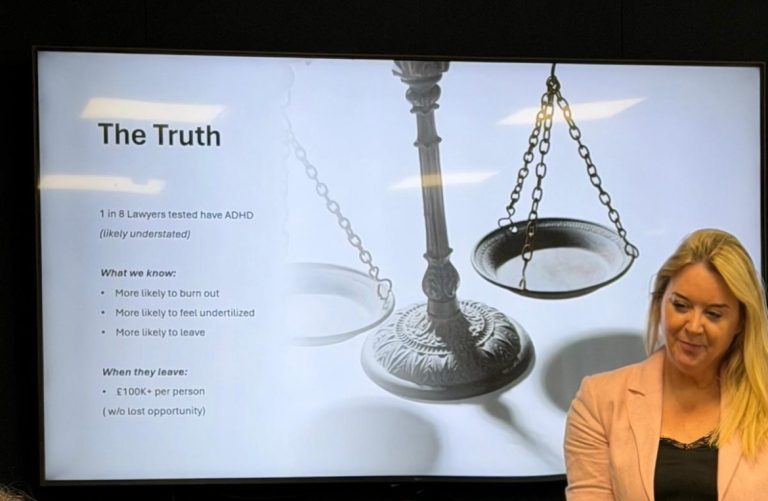
Phillips shared that turning point last week at a private roundtable in London, where general counsel from Nestlé and senior figures from Pinsent Masons, CMS, Freeths and Schroders gathered for a conversation that had nothing to do with reasonable adjustments. The invitation-only session, chaired by former FTSE 100 solicitor Donna McGrath, bypassed traditional diversity frameworks entirely. Instead, it tackled a blunt commercial question: how are law firms haemorrhaging high-potential talent they don’t even realise they have?
The answer, according to participants, lies in neurodivergent lawyers—specifically those with ADHD—who either leave the profession or underperform in systems designed without them in mind.
“One of the most important messages from the roundtable is how easily ADHD talent can be lost before it’s ever understood, even by neurodivergent lawyers themselves,” Phillips explained. “I only received a diagnosis after cycles of burnout, through my employer’s EAP, at a point where I was also struggling with anxiety and wondering whether I be able to continue to work in the profession altogether.”
What happened next surprised him.
“Reasonable adjustments are just the start of the story though, and I think they are a floor not a ceiling in terms of what employers can do. I was lucky to work for a company that already had a really strong and supportive culture and a line manager who backed me. I felt more confident in my role, found my voice and started stepping out of a narrow legal lane and became a much stronger business partner and adviser. I finally found job satisfaction, which had eluded me for most of my career. It was a huge turnaround for me and I think it had a knock on effect on those around me. What it reinforced for me is that this isn’t just about support – it’s about how organisations actively harness that talent. Donna’s work in developing leaders within law firms is critical in this, helping them understand how to identify, support and unlock that potential in a structured and meaningful way.”
McGrath, who now advises general counsel and law firm leaders after her own ADHD diagnosis, has spent months developing what she calls a “See it, Structure it, Scale it” framework. The approach moves firms from awareness—which the legal sector now has in abundance—to implementation, which remains patchy at best.
Her method identifies where neurodiverse talent is currently underutilised, embeds operating models and leadership capability around that talent, then converts it into measurable business impact. It’s a commercial play, not an HR initiative.
“It was vital to host this workshop because ADHD is already shaping performance in legal teams every single day,” McGrath noted. “The question for leadership is no longer about awareness; it is whether firms understand this talent well enough to use it, rather than lose it. This session proved that when we move beyond surface-level EDI and into structured, commercially grounded function design, we unlock a massive hidden asset.”
The timing matters. Legal talent markets have tightened considerably, and firms face mounting pressure to retain high-performers whilst meeting increasingly complex client demands. Meanwhile, traditional legal structures—billable hours, rigid hierarchies, certain partnership models—often constrain the very people who could deliver competitive advantage.
Sharon Johal, General Counsel at Saranac Partners, attended the session. She observed a persistent gap between intention and infrastructure.
“The roundtable highlighted that while law firms are doing a lot in this space, there are still clear gaps in how ADHD is being understood and talked about,” Johal said. “Too often ADHD is positioned as something to be managed, rather than a talent to be harnessed, which can impact how individuals experience the workplace and whether they stay. The systems and frameworks in place can feel disjointed, making it harder to fully unlock that potential. Hearing directly from those with ADHD in the room was particularly powerful and brought a level of honesty that is often missing. Donna’s framework provides a clear and practical way for firms to bridge that gap and start translating intent into meaningful action.”
The dynamic proved unusually frank. Having both private practice partners and in-house leaders in the same room created a level of transparency rarely seen in professional services discussions around neurodiversity. By the end of the session, participants agreed that firms successfully bridging the gap between intent and infrastructure would outperform their peers.
That consensus emerged not from aspirational thinking but from direct testimony. Phillips’ story illustrated what the entire legal sector risks losing when systems fail to accommodate different cognitive profiles. His trajectory—from near-exit to stronger business partner—demonstrates what becomes possible when support structures align with commercial goals.
McGrath plans to run additional workshops over the summer. The response from attendees suggests demand exists for conversations that move beyond compliance rhetoric. For an industry built on precedent, the roundtable may establish a new template: treating neurodiversity not as a risk to manage but as a resource to deploy.
Whether that template spreads beyond a select group of London leaders remains to be seen. What’s clear is that firms ignoring the commercial case—whilst competitors build structured approaches to harnessing ADHD talent—face a retention problem they may not recognise until high-performers like Phillips reach breaking point.
By then, the talent has often already left.