
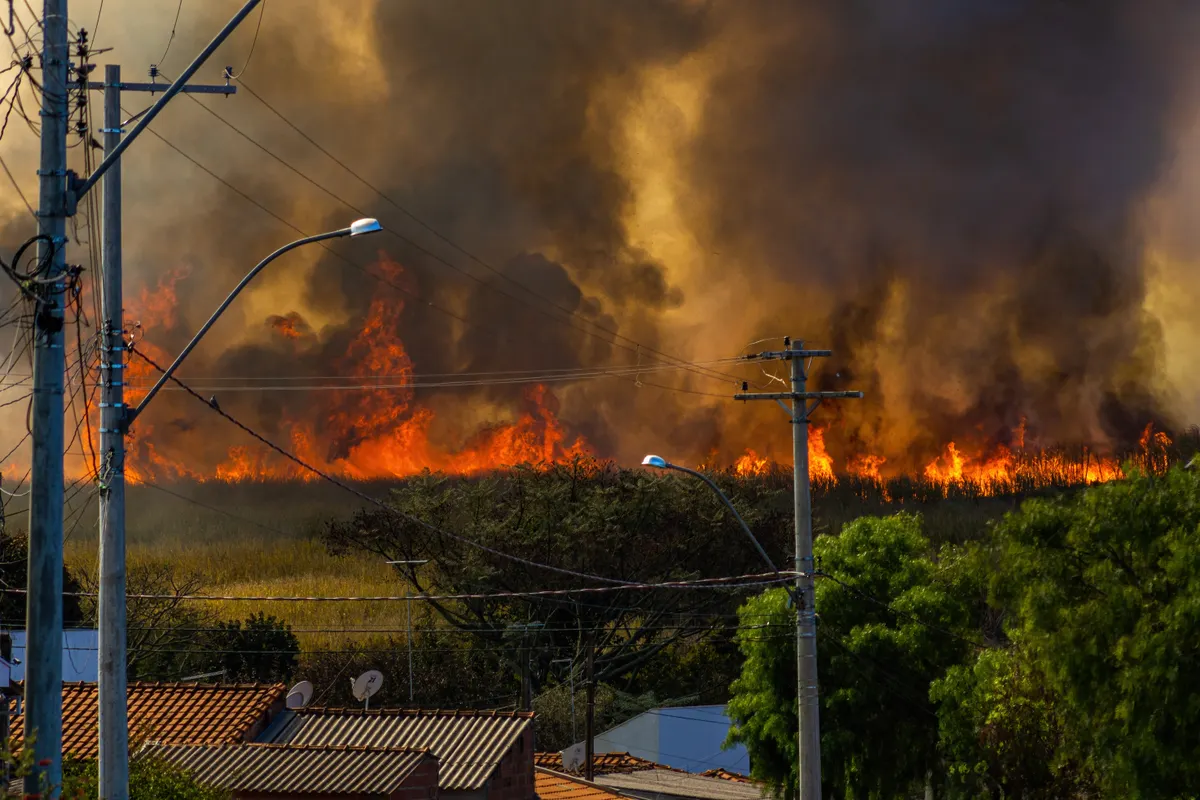

The UN climate chief warning delivered to the European Parliament on Thursday placed Europe’s mounting economic losses from extreme weather at the centre of an increasingly partisan debate, with UNFCCC Executive Secretary Simon Stiell telling MEPs that treating climate action as a political football risks deepening what he described as a ‘continent-wide economic security emergency.’
Stiell’s address came after a summer of record heatwaves across Europe that caused deaths, damaged infrastructure and power stations, triggered mass evacuations, and disrupted trade routes. He estimated the resulting cost at €180 billion in lost productivity and disruption to food, energy, and transport systems.
That figure, attributed by Stiell to a Triodos Bank analysis, is equivalent to roughly 1% of EU GDP, approximately the amount the EU economy is forecast to grow this year, meaning this summer’s extreme weather effectively erased an entire year’s expected economic expansion.
UN Climate Chief Warning on Fossil Fuel Dependency and a Looming Winter Crisis
Stiell linked Europe’s economic vulnerability directly to its continued fossil fuel dependency, warning that another winter fuel crisis looms for European households and businesses. In remarks reported by the UN Regional Information Centre for Western Europe at a separate Brussels address, he warned that electricity prices are spiralling and inflation will likely return, partly because conflict in the Middle East has pushed oil and gas prices higher, as the war in Ukraine did before it.
In his parliamentary statement, Stiell said: ‘Climate impacts like extreme heat are killing thousands, driving up costs, hitting economies and energy security. Inflation is a common enemy, security is a common cause. Both demand action on climate.’
The €180 billion Triodos Bank estimate sits alongside a separate set of projections. Researchers from the University of Mannheim and the European Central Bank (ECB), writing for the EU’s Climate-ADAPT platform, placed losses from extreme summer weather at €43 billion in 2025 alone, with cumulative costs projected to reach €126 billion by 2029. The two estimates measure different time periods and methodological scopes, so they are not directly comparable, but together they indicate a consistent direction of travel for economic damage.
COP31 in Türkiye: Methane, Food Security, and the 1.5°C Question
Looking ahead to the UN Climate Change Conference, Stiell called on the European Union to play an active role at COP31, which is to be hosted by Türkiye. He urged EU member states to focus on implementing existing commitments rather than reopening previous agreements, and identified methane reduction, food security, and urban resilience as the priority areas for EU-led action at the conference.
On the question of temperature targets, UN News reports that a recent UN Environment Programme (UNEP) assessment found the 1.5°C limit set out in the Paris Agreement will be breached, though only temporarily, if the world takes concerted action to subsequently bring temperatures back down. Without such action, Stiell warned, existing global policies put the world on course for 2.6°C of warming.
Stiell also pointed to the broader geographic reach of the crisis, noting that floods and heat-driven power shortages have affected countries well beyond Europe, and that climate disruption is increasingly fuelling forced migration both within and across borders.
The climate crisis also reinforces global inequality: developing nations, which contribute least to cumulative emissions, bear a disproportionate share of the consequences. Stiell’s call for international cooperation at COP31 reflects longstanding UN concern that existing commitments remain insufficient to close the gap between current policy trajectories and the Paris Agreement’s targets.
Whether EU member states translate Stiell’s call into concrete pledges at COP31 in Türkiye will be an early indicator of whether his warning about partisan drift carries political weight with the governments that must act on it.
