
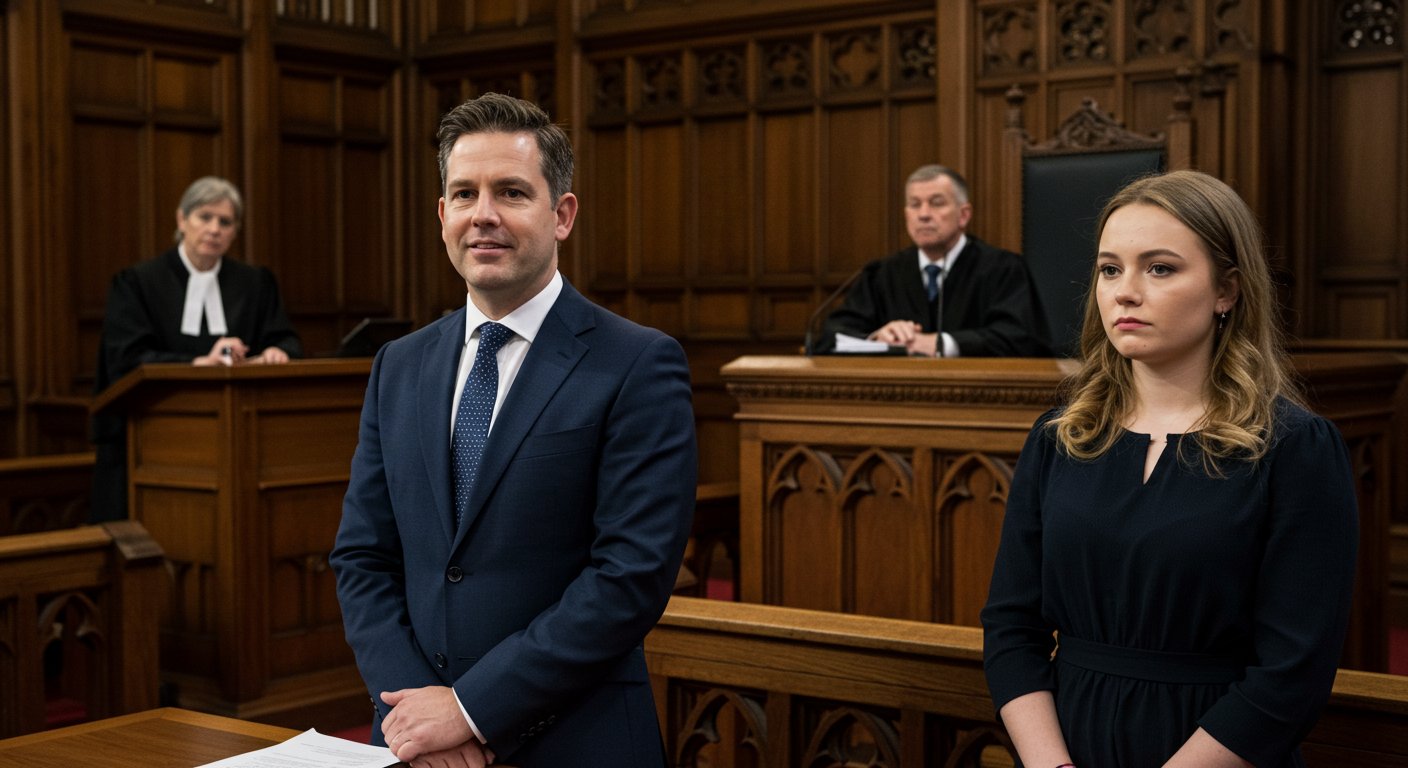

The first surprise for most people attending a Crown Court trial is how ordinary the building feels inside once you get past the security arch. There are no sweeping speeches in corridors, no dramatic confessions on courthouse steps. Mostly, there is waiting. Lawyers with heavy bags. Families whispering over paper cups of coffee. A digital board flickering with case numbers that mean everything to someone and nothing to everyone else.
Crown Court trials deal with the most serious criminal cases in England and Wales — robbery, rape, serious assault, complex fraud, and homicide among them — along with “either-way” offences that magistrates decide are too serious to keep. By the time a case arrives here, it has already passed through earlier procedural stages. Pleas may have been entered. Evidence schedules exchanged. Deadlines missed and reset. The trial itself is not the beginning of the story but the part the public sees.
The courtroom is structured around roles more than personalities. The judge sits elevated, managing procedure and legal rulings. The jury sits to one side, usually twelve strangers brought together by random selection. Counsel face forward. The defendant sits in the dock, sometimes behind glass depending on security assessment. It is less theatrical than people expect and more choreographed. Everyone knows when to stand, when to sit, when to speak — except, often, the witnesses.
The prosecution goes first. That is not a matter of strategy but burden. The state must prove guilt beyond reasonable doubt, and the sequence reflects that responsibility. Opening speeches are meant to be roadmaps, not performances, though styles vary widely. Some prosecutors are spare and clinical. Others build narrative carefully, almost like patient teachers walking a class through difficult material. The defence may give an opening immediately or wait until later, depending on approach.
Evidence unfolds in pieces rather than revelations. CCTV clips are paused and replayed. Phone records are read aloud in a steady voice that drains them of drama. Forensic reports are summarised line by line. Jurors take notes, though they are told not to treat them as transcripts. The pace can feel slow until suddenly it isn’t — a witness contradicts an earlier statement, a timeline tightens, a phrase lands awkwardly and hangs in the air longer than expected.
Witness testimony is where unpredictability lives. Even prepared witnesses can falter under cross-examination. Barristers are trained not just to ask questions but to control tempo. Short questions. Closed questions. No room to wander. A good cross-examination often sounds polite to the untrained ear, almost gentle, while quietly narrowing the path until only one answer remains plausible. Bad cross-examination sounds like arguing. Judges tend to intervene quickly when it drifts there.
Defendants are not required to give evidence, and juries are instructed not to assume guilt if they remain silent. Still, when a defendant does enter the witness box, the room’s attention sharpens noticeably. It changes the emotional temperature. The abstract becomes personal. Jurors lean forward. Pens move faster.
Courtroom language is plainer than it used to be, but legal directions can still sound dense. Judges give what are called “summing up” directions before the jury retires — explaining the law, outlining the issues, reminding jurors of key evidence from both sides. They are careful not to tell jurors what verdict to reach, but the framing matters. The phrasing matters. I’ve noticed how a judge’s tone — brisk, patient, slightly weary — can subtly shape how the whole exercise feels.
Trials rarely run straight through like television versions. There are frequent pauses while legal arguments are handled without the jury present. These can concern admissibility of evidence, wording of charges, or procedural disputes. The jury is asked to step out. Lawyers cluster. The judge speaks more freely. Ten minutes becomes forty. Then everyone resets and the performance resumes, smoother than before.
The jury’s role is narrower than many assume. Jurors decide facts, not law. They are not investigators and cannot conduct outside research. They must ignore media coverage and decide only on what is presented in court. When they retire to deliberate, they go into a private room with their notes and the exhibits allowed. No phones. No internet. Just discussion. Sometimes quick. Sometimes painfully divided.
Majority verdicts are permitted in many situations — typically 10–2 or 11–1 — but only after sufficient deliberation time. Before that threshold, the judge must ask for unanimity. That waiting period can stretch nerves across the building. Lawyers try not to speculate out loud. Families read meaning into how long the jury has been out, though duration is a poor predictor.
Sentencing, if there is a guilty verdict, is the judge’s responsibility alone. Sometimes it happens immediately. Sometimes it is adjourned for reports — pre-sentence assessments, psychological evaluations, risk analyses. Sentencing remarks are delivered publicly and are often more detailed than people expect. Judges explain not just the punishment but the reasoning path: harm caused, culpability level, mitigating factors, prior record. It is one of the few moments where the system speaks in a fully reasoned voice.
The emotional asymmetry is striking. For professionals, it is one case among many. For defendants and families, it is often the central crisis of their lives. You can see it in the way relatives sit — upright, hands folded tight — while clerks discuss scheduling with routine efficiency. Neither stance is wrong. They simply belong to different worlds that intersect for a few days.
Court staff are the quiet stabilisers. Ushers guide confused witnesses through back corridors. Clerks keep the paperwork flowing. Security officers manage tensions before they become incidents. Their names are rarely reported, but proceedings would stall without them. Regular observers learn quickly that the smoothness of a trial often depends less on courtroom brilliance and more on backstage competence.
There is also a great deal that never reaches the jury. Prior convictions may be excluded. Certain lines of questioning are ruled unfair. Entire arguments happen in legal submissions that jurors never hear. That filtering is intentional — designed to protect fairness — but it can make verdicts look mysterious from the outside. They are built on a curated version of the full dispute.
Delays are common. Witnesses fall ill. Evidence arrives late. Legal points trigger adjournments. The public sometimes reads delay as weakness in the case, but often it reflects caution. Criminal procedure in the UK leans heavily toward avoiding wrongful conviction, even at the cost of speed. Whether it always succeeds is debated fiercely in legal circles.
What stays with you after observing several Crown Court trials is not drama but accumulation. Detail upon detail. Careful rules. Human fallibility contained within formal structure. The system is neither as cold nor as theatrical as outsiders imagine. It is procedural, imperfect, and deeply serious about the act of deciding guilt.
And when the jury files back in and the clerk asks for the verdict, the room always goes completely still.
