
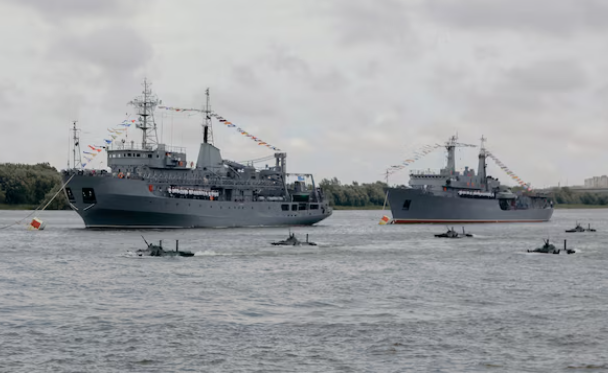

In an unplanned moment, two steel giants brushed against one another out on placid blue waters. It took place during a replenishment-at-sea operation, which is a complex, high-pressure ballet in which enormous ships move side by side while in motion, connected by systems for cargo transfer and fuel lines. The USS Truxtun and USNS Supply didn’t glide as smoothly as they should have on this particular occasion. Rather, they ran into each other.
Despite not being catastrophic, the collision raised concerns right away for everyone in the chain of command. Although they are routine, these exercises are rarely informal. They are based on meticulous ship handling, coordinated communications, and rehearsed choreography. In this case, there was a momentary lapse in that rhythm, and two sailors left with minor injuries. It is noteworthy that both ships were still seaworthy, indicating that there was no significant structural compromise. However, the Navy believes that even slight contact between ships causes a significant pause.
Key Facts on the US Navy Ship Collision in the Caribbean
| Incident Detail | Description |
|---|---|
| Date of Collision | Wednesday, February 2026 |
| Location | Caribbean Sea (U.S. Southern Command jurisdiction) |
| Ships Involved | USS Truxtun (DDG-103) and USNS Supply (T-AOE-6) |
| Nature of Incident | Collision during replenishment-at-sea maneuver |
| Additional Ship Present | USS Gettysburg (CG-64), positioned on the opposite side of USNS Supply |
| Reported Injuries | Two personnel sustained minor injuries |
| Ship Condition | Both ships remained seaworthy and operational |
| Mission Context | Part of Fourth Fleet anti-trafficking operations near South America |
| Investigative Status | Navy-led investigation currently underway |
| Expected Follow-up | Procedural review, training audit, and possible repairs |
This was not a tumultuous battleground. It was a controlled logistical support exercise. Alongside ships like the USS Gerald R. Ford and USS Gettysburg, the Truxtun, a guided missile destroyer recently assigned to the Navy’s Fourth Fleet, had been conducting operations in Caribbean waters. Their goal was very clear: to enforce restrictions on the movement of Venezuelan oil and to support operations that target illegal drug trafficking. Because these operations rely so heavily on endurance and mobility, timely replenishments at sea are necessary.
The tension that rises during the approach is evident to anyone who has witnessed one of these refueling maneuvers up close. Cables swing across water, crews wait at the railings, and even the slightest error in speed or angle can cause contact. In addition to being extremely efficient, this process is also very harsh.
The fact that the USS Gettysburg was allegedly on the far side of the USNS Supply during the exercise gives this incident an additional dimension. Although not unusual, this three-ship arrangement increases the need for coordination and spatial awareness. By supplying combat vessels with materials, ammunition, and fuel in the middle of a mission, replenishment ships such as the Supply act as floating lifelines. They aren’t made to move quickly or maneuver in combat. Incidents involving them, particularly during a controlled evolution, garner attention because they are workhorses.
There is no sign that this will become a serious operational emergency. Nonetheless, these instances are rarely disregarded in naval culture. They remind us that routines, even in peacetime, need to be precise. As a journalist who has previously covered ongoing operations, I can recall how quiet everything got right before the fuel line was locked. The ship seems to have taken a collective breath.
Both vessels are being inspected as per protocol. The Navy’s internal review procedure is probably going to look at everything from crew sleep schedules to recordings of bridge communications. These tests are meant to identify trends rather than assign blame; was there a training failure? Did weariness play a role? Was the maneuver appropriately adjusted for environmental conditions? Every response strengthens procedural resilience.
These events also have a financial component. Even though preliminary indications point to only minor physical harm, naval operations don’t take presumptions for granted. Technicians will make sure the replenishment rigging is intact, test the hull plating, and align the sensors. If repairs are required, they will probably be incorporated into regular maintenance plans to cause the least amount of inconvenience. Operational accounts, not emergency budgets, are used for these.
The Navy has experienced a number of maritime mishaps in the last 12 months. The limitations of operational readiness under stress were brought to light during the USS Harry S. Truman’s deployment in the Middle East by a number of incidents, including a friendly fire error and the loss of two fighter jets. Although those incidents were more severe than this one, they all point to the same fundamental problem: there is an increasingly narrow margin for error and an exceptionally high demand on fleet readiness.
Deploying autonomous navigational aids during these high-risk operations may rekindle interest among defense technology advocates and industry observers. Already being tested in fleet trials, AI-assisted maneuver planning may gain traction as a means of lowering human error. The debate will intensify regardless of whether those systems will turn out to be exceptionally successful or merely an additional layer of complexity.
However, the incident gets to the deck sooner than that conversation does. Today’s replenishment exercises will probably involve sailors performing their own mental audits, which may include reviewing diagrams, rechecking timing, and remembering commands. That kind of introspection is encouraged by Navy culture. Every ship gains knowledge from another’s mishaps. That is the method by which institutional memory is created—quietly, diligently, and occasionally harshly.
At-sea replenishments will go on. They have to. Mobility is essential to naval operations, and mobility necessitates resupply. The mission won’t be stopped by this collision, though it might cause a brief slowdown. If anything, it turns into a piece of information that improves the operational edge of the entire fleet.
