


Most law firm websites suffer from a massive structural mismatch. They are organized exactly the way the firm operates internally, featuring dense menus dividing practice areas, long lists of attorney biographies, and pages dedicated to recent industry accolades. However, a prospective client does not think about your internal hierarchy. They arrive at your site with a single pressing thought: I have a problem, and I need to know if you can solve it.
This structural mismatch quietly costs legal practices both search visibility and new client conversions. When you force visitors to dig through an org-chart layout just to find an answer, they often leave. Fortunately, you can fix this. Reorienting your law firm website around user intent from the ground up changes everything. Modern tools make it easy to build your site with a client-first framework from the get-go, so you don’t have to retrofit an old, clunky design later on. For example, Wix provides an AI website generator that generates beautiful, fully customizable websites with a super intuitive flow.
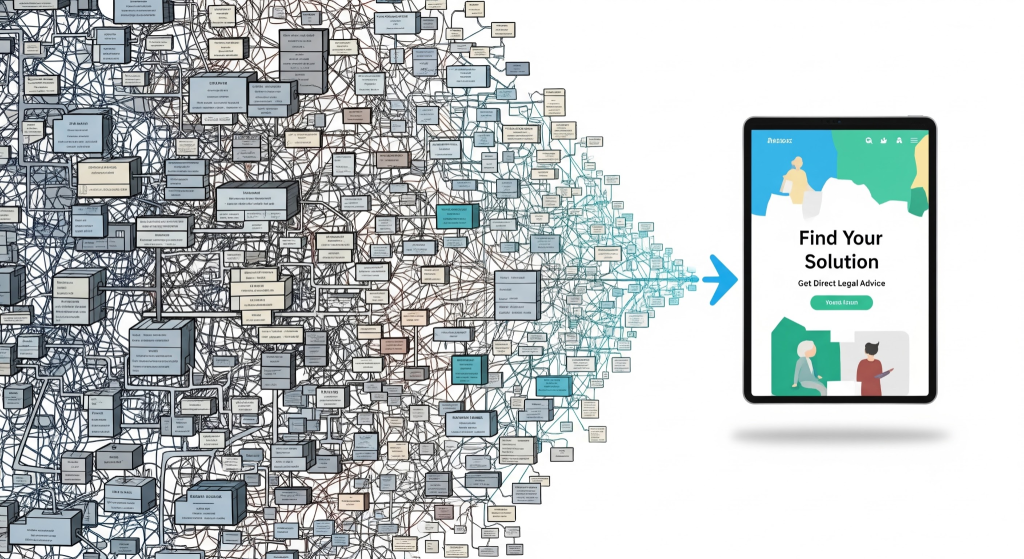
Why Law Firm Websites Are Built for the Partner Meeting, Not the Potential Client
The instinct to organize a website around firm hierarchy is incredibly common. It happens because firms prioritize their internal identity over external relevance. A law firm wants to show off its various departments and partner achievements. But a prospective client does not care about how your departments are structured. They arrive with a specific problem, such as a looming divorce or a contract dispute, and they want to know immediately whether your firm handles that exact issue.
The architecture of most legal sites forces visitors to decode the firm’s structure before they can find what they actually need. This creates unnecessary friction. When a user has to click through three different “Practice Area” dropdowns to figure out if you handle their specific type of case, they lose patience. This friction hurts your conversion rates and sends negative signals to search engines.
Instead of letting your internal structure dictate your site layout, you should map your pages to the exact problems your clients face. Using an ai website generator, which is naturally designed around modern user behavior patterns, allows you to surface a client-first structure right from the outset. You can easily build a layout that speaks directly to the visitor’s needs rather than inheriting an outdated org-chart template.
What Search Behavior Actually Reveals About How Legal Clients Think
Keyword data tells a fascinating story about legal clients. It shows that people rarely search for specific firm names or broad practice area labels unless they already have a referral. Instead, they search for outcomes, specific situations, and pressing questions. They type queries like “what happens after a DUI arrest” or “how to split a business in a divorce.”
Aligning your page structure, your main headings, and your content to match those exact queries is a brilliant SEO move. It also serves as an immediate trust signal. When a user searches for a specific question and lands on a page that directly answers it, they instantly feel understood. You prove your competence before they even pick up the phone.
This intent-focused approach is becoming even more critical. Look at the evolving landscape around AI regulation and how new technologies are constantly reshaping search visibility for professional service providers. Search engines increasingly prioritize highly relevant, intent-driven answers over generic landing pages. Creating content that directly addresses your client’s specific questions is no longer just a nice-to-have addition; it is a strict competitive necessity.
The Credibility Signals That Turn Visitors Into Consultation Requests
Once you capture traffic through intent-driven content, you must focus on your trust architecture. Credibility is communicated to a visitor before they read a single word of your legal analysis. They instantly judge your practice based on your load speed, visual clarity, and mobile responsiveness. If your site takes ten seconds to load on a smartphone, the user will leave, assuming your legal services are just as slow and outdated.
You also need real social proof placed prominently on your pages. Client testimonials, specific case outcomes, and recognizable press mentions do the heavy lifting of proving your expertise. These elements show the user that you have successfully solved problems exactly like theirs.
Investing in this level of thoughtful web design builds a strong business case, particularly for smaller or newer practices trying to compete against established firms with massive marketing budgets. You do not need a fifty-person marketing team to look highly professional. A wave of AI startups and legal tech companies are actively raising the bar for what a professional services website is expected to look and behave like. By adopting a clean, fast, and trust-focused design, you can easily punch above your weight class and win clients away from the legacy firms.
Designing for the Client You Want to Serve, Not the Firm You Have Built
Brand strategy for law firms is frequently misunderstood as a simple aesthetic choice. Many partners think branding just means picking a nice shade of blue and a serious-looking font. In reality, your brand encompasses your tone of voice, the specificity of the problems you claim to solve, and the visual signals that communicate exactly who your firm is for.
A practice that primarily serves first-generation business owners needs a fundamentally different site than a firm serving massive corporate M&A clients. The business owner needs approachable, straightforward language and clear pricing structures. The corporate client expects deep industry reports, formal case studies, and a highly polished corporate tone.
User intent-driven design is exactly what makes that specificity visible and credible to the right audience. When you design around the user, you naturally adopt their language. You stop using confusing legal jargon and start using the terms your clients use to describe their own problems. This deep alignment shows the client that you belong in their world.
Clients Do Not Care About Your Org Chart. Your Website Should Not Either.
Moving from a firm-centered website to a client-centered website is a massive strategic shift. It simultaneously improves your SEO, clarifies your brand positioning, and dramatically increases your conversion rate. When you stop talking about how your firm is organized and start talking about how you solve problems, everything clicks into place.
You can start making this shift today. Audit your current site’s main navigation and homepage from the perspective of someone who has never heard of your firm and is currently dealing with a stressful legal problem. Ask yourself if they can find the exact solution they need within three seconds. If they cannot, it is time to rebuild. That perspective, not your internal structure, serves as the ultimate blueprint for every single page on your site. Put your clients first, answer their questions clearly, and watch your consultation requests grow.
