
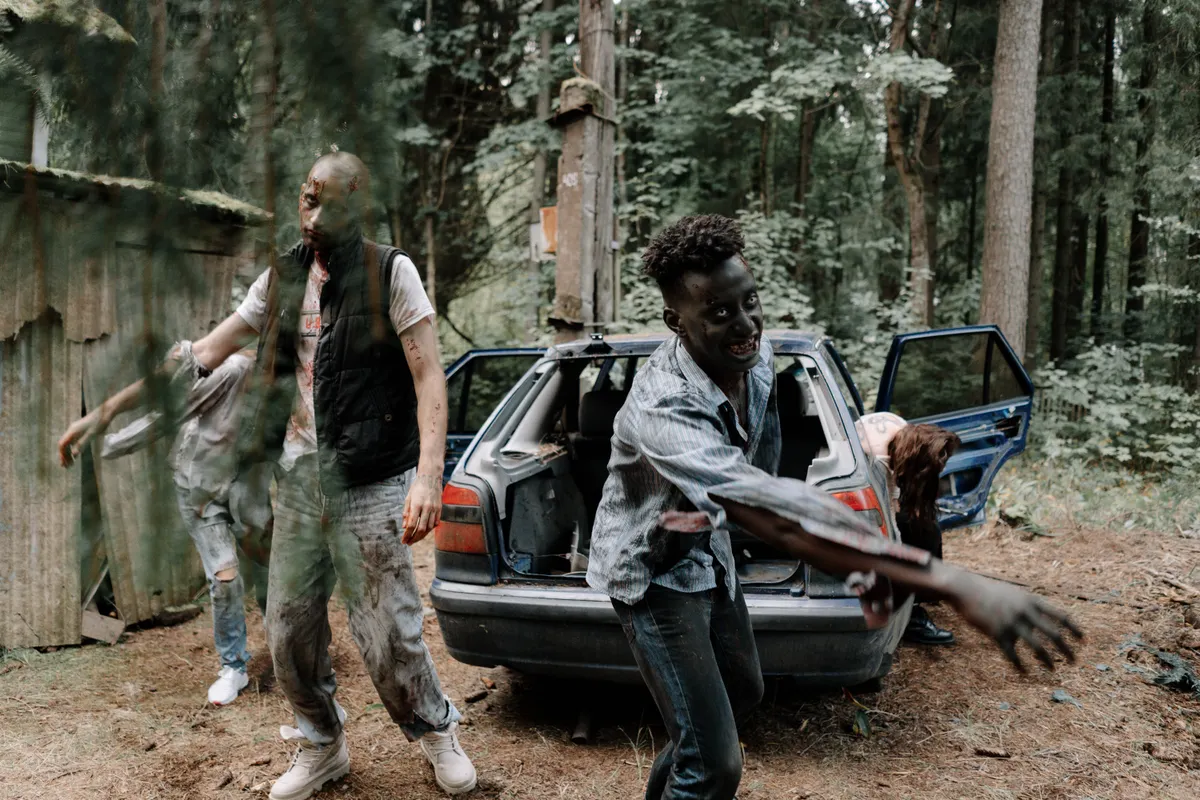

The Resident Evil reboot directed by Zach Cregger is the most fluent translation of video game logic into film language that mainstream cinema has yet produced, and it is, improbably, also very funny. Released theatrically after its premiere at Fantastic Fest on 17 September 2026, the film stars Austin Abrams as Bryan, a medical courier who stumbles through an escalating series of survival scenarios in the distinctly empty, distinctly creepy Raccoon City.
What the Resident Evil Reboot Gets Right
Bryan is not a gun guy. He says so repeatedly, and proves it just as often, firing just wide of targets at close range, discharging weapons accidentally, rooting through drawers for ammunition. The joke is that his incompetence mirrors the experience of an actual video game player, the person cursing at the television as a newly found shotgun goes off into a wall. It is a running gag, and it lands every time, because Cregger never lets it feel like a wink to camera. The consequences are real; the comedy comes from the situation itself.
The film is structured as a series of discrete environments that function, without apology, as levels. Each brings a new challenge: white-knuckle combat, platform movement, environmental puzzles. Power-up weapons appear in a logical progression. Padlocked gates require shooting. Ladders are conveniently placed. The film is approximately 90 minutes long, and it does not waste a frame of that time, moving through its levels with the propulsiveness of a well-designed game session.
Cregger co-wrote the screenplay with Shay Hatten, who wrote John Wick, and the collaboration shows in the action’s internal logic. Each set-piece follows rules that the film establishes and then complicates, in the manner of a game designer raising the difficulty between stages. The cast around Abrams includes Paul Walter Hauser, Zach Cherry, and Kali Reis, with Hauser best known for his Emmy and Golden Globe-winning performance in Apple TV+’s Black Bird.
At CinemaCon earlier this year, Cregger said he had played ‘a sh*t ton of Resident Evil’ over the past couple of decades, and that the games are ‘so naturally cinematic,’ adding that fans ‘will feel their influence everywhere in the movie.’ He was not overstating it. The Umbrella Corporation is present. So are the zombie-esque creatures, the fog-laden city, the institutional dread. But Cregger uses the franchise’s lore as scaffolding rather than as scripture.
How Cregger’s Background Shapes the Film
Before Barbarian (2022), which grossed $46 million and announced him as a genre director worth watching, and before Weapons (2025), which earned an Oscar nomination and saw Amy Madigan win Best Supporting Actress, Cregger was a founding member of sketch comedy group The Whitest Kids U’ Know. That background is audible throughout. Each level in Resident Evil plays like a sketch, a chain of yes-and escalations that stack improbable complication upon improbable complication until the scenario collapses, and the next one begins.
The approach distinguishes this film sharply from its predecessors. The previous live-action Resident Evil franchise, which ran from the Milla Jovovich- and Michelle Rodriguez-led original in 2002 through Resident Evil: The Final Chapter in 2017, plus Johannes Roberts’s 2021 standalone reboot Resident Evil: Welcome to Raccoon City, grossed more than $1.2 billion worldwide across its run, according to Variety. Those films leaned on inscrutable lore and Jovovich’s physicality. They were camp in the most functional sense: goofy, trashy, pseudo-serious, comfortable in their goofiness. Cregger’s version is something else: it is a film that treats the grammar of games as a legitimate artistic register.
Most video game adaptations either replicate specific game sequences (the first-person corridor in the original Doom film being the canonical example) or construct a character-driven narrative that dutifully adheres to game lore while hoping audiences forget how thin that lore usually is. This year’s Mortal Kombat sequel fell into the second category. Cregger does neither. He takes the structure of the game experience itself and makes that the film.
The film is produced by Constantin Film alongside PlayStation Productions and Vertigo Entertainment, with Sony’s Columbia Pictures distributing. It was shot for IMAX. Those production decisions suggest a franchise ambition that the film, to its credit, earns on its own terms rather than by demanding goodwill from brand loyalty.
Near the end, having dispatched a major creature, Bryan yells ‘VIDEOOOOO GAAAAAAMES.’ It is the slogan of someone who has been through something, and also the punchline of a film that has spent 90 minutes proving that the language of games, aimed properly, can carry a cinema audience just as far as any other genre. A prequel built around Amy Madigan’s Oscar-winning Weapons character is already greenlit. Whether that project follows Cregger’s game-first instinct or retreats to safer ground will be the more interesting question to answer.
