
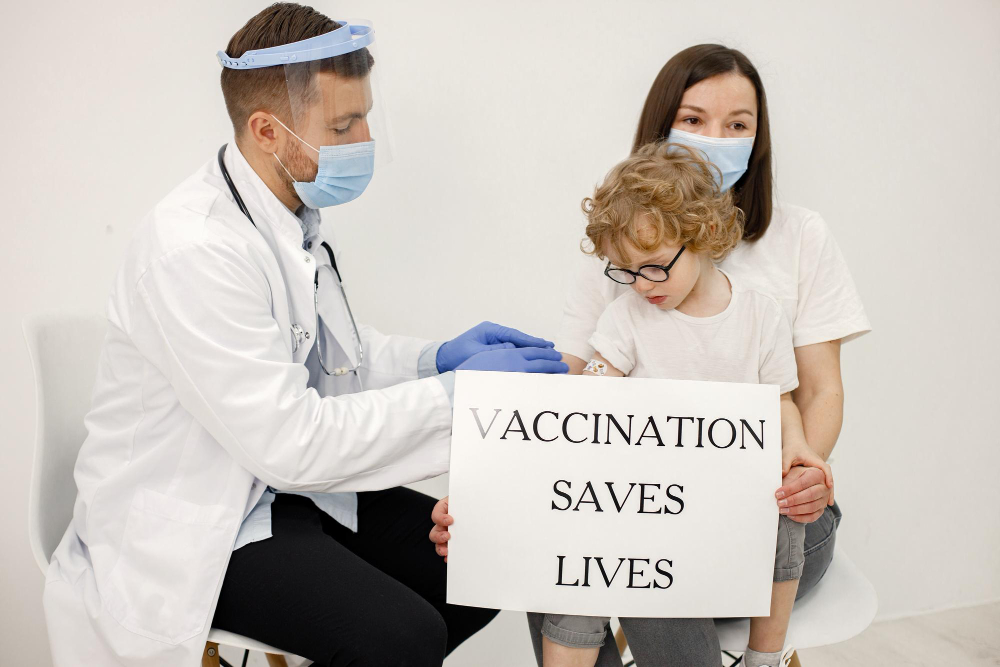

The waiting area of a pediatric clinic in Ohio appears to be a typical setting on a calm winter morning. Parents looking through vintage periodicals. Kids pulling at colorful plastic toys strewn all over the carpet. However, doctors are now asking a question they thought they would never have to ask again: “Is your child vaccinated against measles?” behind the exam room doors.
The United States had a proud public health label for over 20 years. In 2000, measles was “eliminated,” which meant that the virus was no longer consistently spreading throughout the nation. Outbreaks were small and swiftly contained, although cases continued to occur occasionally and were typically brought in by international travel.
| Category | Details |
|---|---|
| Disease | Measles (Rubeola) |
| Virus Type | Highly contagious respiratory virus |
| U.S. Elimination Year | 2000 |
| Vaccine | MMR (Measles, Mumps, Rubella) |
| Vaccine Effectiveness | ~97% after two doses |
| Herd Immunity Threshold | ~95% vaccination coverage |
| Recent U.S. Cases | 2,283 cases reported in 2025 |
| 2026 Cases (early) | 1,281 confirmed cases |
| Reference | https://www.cdc.gov/measles |
Now, that distinction might be eroding. Measles cases are rapidly increasing nationwide, according to recent data. Over 2,200 confirmed cases were reported in 2025 alone, the most in decades. More than 1,200 new infections had been reported in dozens of states by the beginning of 2026. As the numbers rise, epidemiologists are starting to talk cautiously about what used to seem nearly unimaginable: the potential for the United States to lose its status as a measles-free country.
“Measles-free” can be a deceptive term. It did not imply that the virus was no longer present. Rather, it signified that the nation had effectively prevented the disease from establishing ongoing local transmission for a minimum of a year.
The designation vanishes if you lose that control. Practically speaking, that would mean measles would once again be regarded as endemic—circulating frequently as opposed to occasionally showing up as imported sparks.
Although it may seem like a technical distinction, public health officials view it as a warning sign.
The stakes seem more real when you’re in a hospital ward during a measles outbreak. The disease spreads surprisingly well. In a population with low immunity, one infected person can spread the virus to 12 to 18 other people. It moves swiftly in crowded areas like schools, airports, and daycare centers.
It is frequently referred to by doctors as one of the most contagious viruses that people are aware of.
The recent outbreaks are remarkably similar to vaccination gaps. Currently, unvaccinated or inadequately vaccinated individuals account for about 90% of measles cases in the US. In certain communities, vaccination rates have fallen below the crucial 95 percent threshold required for herd immunity.
Because measles doesn’t only threaten people who don’t get vaccinated, that threshold is important.
Cancer patients with compromised immune systems, infants too young to receive the vaccine, and others who are medically incapable of receiving it rely on the protection of the community. These imperceptible barriers begin to weaken when vaccination rates decline.
Over the past ten years, public health officials have observed this pattern gradually developing. Coverage levels that once appeared to be almost automatic have been subtly eroded by vaccine skepticism, false information on the internet, and a decline in institutional trust.
That erosion may have been accelerated during the pandemic years. Routine vaccinations were interrupted by school closures. Resources from already overburdened health departments were redirected to the COVID response. Additionally, the larger cultural discussion surrounding vaccines grew more heated and divisive.
As a result, the nation’s immunity is uneven, with some states maintaining high vaccination rates and others significantly below the advised thresholds.
The outbreak maps show the consequences. In communities where vaccination rates decline, clusters frequently form. Measles spreads swiftly once it reaches those areas before public health teams can stop it. The cost of containment itself is high. When investigations, testing, and contact tracing are taken into account, public health systems may have to spend tens of thousands of dollars managing a single measles case, according to studies.
The financial cost increases surprisingly when you multiply that by hundreds or thousands of infections.
Cost isn’t the only issue, though. It’s momentum. As the trend develops, epidemiologists are quietly concerned that measles might be putting America’s public health system to the test. The nation would formally lose the elimination status it has had since 2000 if transmission persisted for twelve months in a row.
That would put the US in a different category, one where measles is a common occurrence rather than an occasional outbreak.
In recent years, other nations have already stepped over that boundary. Following prolonged transmission, Canada recently lost its elimination designation. Similar setbacks have occurred in a number of European countries, frequently as a result of falling vaccination rates.
Geography is what makes the American situation so complex. Every year, millions of foreign visitors arrive in the United States. Cases from abroad are unavoidable. Controlling those sparks as soon as possible is essential to preserving elimination status before they start more extensive infection chains.
That calls for ongoing attention to detail. Campaigns for vaccinations continue to be the most effective instrument available. One of the most effective vaccines ever created by medicine, the MMR vaccine offers approximately 97 percent protection against infection after two doses. Eliminating the measles was, in many respects, a quiet victory for public health.
which gives the present a peculiarly uneasy feeling. Ironically, a disease that was once driven to the brink by scientific advancement is now resurfacing due to social reluctance rather than a medical constraint.
It’s still unclear if the US will eventually lose its measles-free status. Vaccination campaigns can rapidly restore immunity in susceptible populations, and outbreaks can still be contained.
However, many health experts are attempting to gently rather than alarmingly convey the message that the recent surge carries.
The measles never really went away. It just awaited the circumstances that would permit it to come back.
