
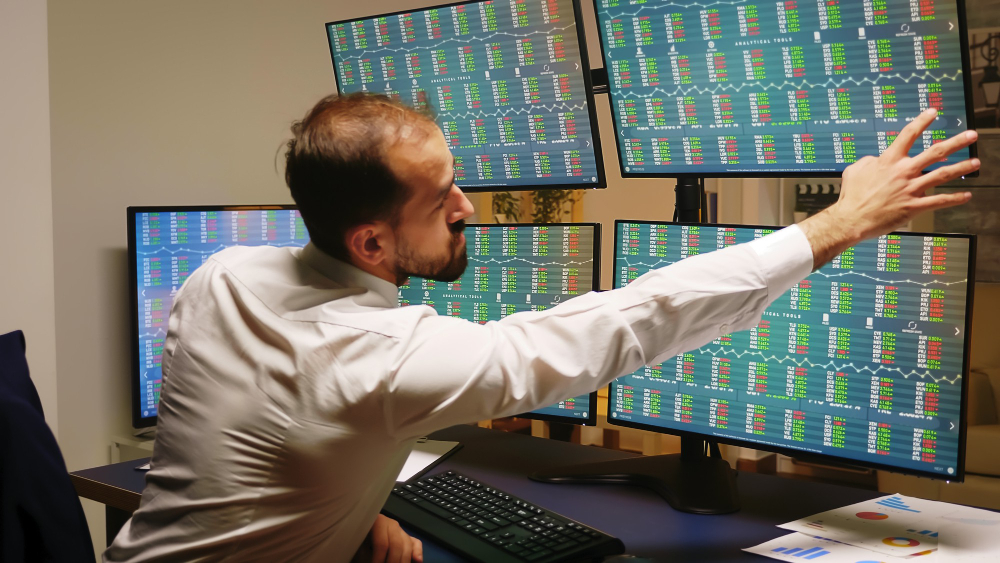

The price board in the stock market can appear almost unreal on some mornings. Before most investors have even finished their coffee, a company that was trading at $12 the day before opens at $9. Overnight, another jumps 18%, but by midday, it returns half of it. It’s like watching a weather system that won’t settle when you watch the quantum computing industry these days.
Once the trendiest area of speculative technology investing, quantum stocks are now experiencing a price increase. Additionally, they’re working fast—sometimes overnight.
Simple math plays a part in the explanation. A few publicly traded quantum computing firms have produced staggering returns in the last 12 months. Almost overnight, some shares surged more than 2,000%, transforming obscure laboratory startups into multibillion-dollar market sensations. For a while, investors appeared prepared to treat the industry similarly to how they used to treat electric cars or artificial intelligence in their early hype cycles.
| Category | Details |
|---|---|
| Sector | Quantum Computing |
| Key Companies | IonQ, Rigetti Computing, D-Wave Quantum, Quantum Computing Inc. |
| Typical Market Stage | Early-stage, mostly pre-profit companies |
| Market Valuations | Often trading 100x–2000x sales |
| Estimated Industry Size | ~$1B today, projected up to ~$198B by 2040 |
| Stock Volatility | Some stocks rose more than 2,000% in a year |
| Investor Concern | Profitability timelines and speculative valuations |
| Reference | https://finance.yahoo.com |
However, markets eventually have a tendency to pose awkward questions.
Today, the atmosphere is very different when you walk onto a trading floor or browse investor forums. Although the excitement hasn’t completely disappeared, it has become more akin to cautious curiosity. A large number of businesses at the core of the quantum surge continue to make very little money, sometimes just a few hundred thousand dollars every quarter.
When it comes to money, that is hardly a rounding error. However, until recently, their valuations were comparable to those of established tech firms. Some sold for hundreds or even thousands of dollars a year. Even in the technology industry, where investors frequently accept protracted periods of unprofitability in exchange for possible breakthroughs, those figures are remarkable.
The recent repricing may be a reflection of a quiet realization that is permeating Wall Street: practical quantum computing may take longer than many had anticipated.
That has even been alluded to by some of the leading proponents of the technology. Jensen Huang, the CEO of Nvidia, famously predicted that it might take decades before there are truly useful quantum computers. The remark nearly immediately sent shockwaves through the financial markets. Investors were forced to reconsider their models after joyfully predicting commercial breakthroughs in the coming years.
Additionally, prices often follow changes in expectations. The overall state of the economy is another factor. Stocks in quantum computing companies are categorized as “long-duration assets” by traders, meaning that their value is largely dependent on future profits. Investors frequently shift their focus from these speculative bets to businesses that are currently producing real cash flow when interest rates are still high or geopolitical tensions cause markets to tremble.
The change can happen quickly. A further layer of uncertainty has been introduced to financial markets by recent geopolitical volatility, which includes Middle East tensions and rising energy prices. These shocks typically hit technology stocks first, and they hit early-stage industries like quantum computing the hardest.
It is evident from recent charts of companies such as Rigetti and Quantum Computing Inc. that the volatility is not subtle.
However, the repricing isn’t entirely bad. Indeed, some analysts contend that the industry may benefit from the recent decline. For months, many investors acknowledged in private that the numbers no longer made sense because valuations had strayed so far from underlying fundamentals.
In that situation, a correction turns into a sort of reset. It’s important to keep in mind that quantum computing is still a truly fascinating technology. Quantum machines use qubits that can represent multiple states at once, in contrast to classical computers that process information in binary bits. Theoretically, that could release vast amounts of computing power for issues with complex simulations, drug development, climate modeling, and cryptography.
The promise is genuine. The mystery lies in the timeline. Engineers are still struggling with the fundamental physics needed to stabilize quantum systems long enough to carry out useful computations in research labs across the country, from California to Canada. Beside fragile processors running at almost zero degrees, cooling apparatus hums. Calculations can be affected by even tiny vibrations.
The science is fascinating. However, it is difficult to translate into quarterly financial reports.
The behavior of the market also has an intriguing psychological component. Recent history has conditioned investors to think that innovative technologies, such as artificial intelligence (AI), cloud computing, and electric vehicles, can scale practically overnight once the proper tipping point occurs.
The pace of quantum computing might be different. Before it ever achieves the broad metamorphosis that many enthusiasts envision, it might develop gradually, progressing from scholarly research to specialized commercial applications. If so, current market values might just be adapting to a more practical timeline.
The similarities to previous technological cycles are difficult to ignore. In addition to remarkable innovation, the dot-com bubble of the late 1990s also caused spectacular stock collapses. The world was eventually changed by the technology, though not always by the businesses that investors first placed their bets on.
Maybe something similar is happening here. In the future, quantum computing is probably going to be very important. That’s what most serious technologists think. However, because they are naturally impatient, markets prefer innovations that happen on a set timetable.
For the time being, the industry is going through a period of review. Following analyst notes, earnings reports, or geopolitical news, prices may move significantly. Although they are still far from conventional measures, valuations are moving closer to the fundamentals.
It could feel dramatic to repricing overnight. However, it seems almost familiar given the lengthy history of technology investment. Hype spreads swiftly. Usually, reality comes a little later.
