
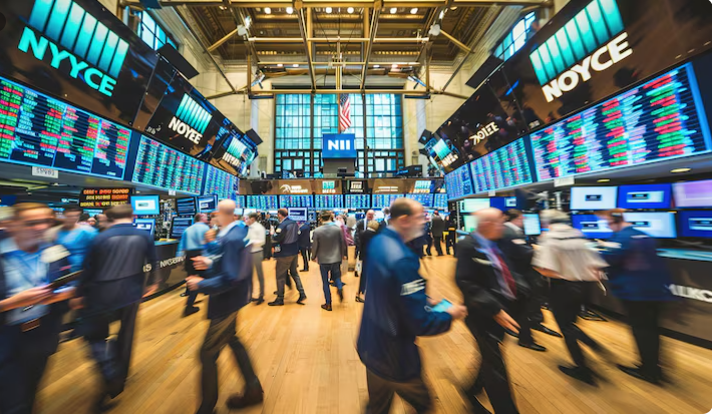

Toronto’s morning traffic passes the financial district’s glass towers slowly. Screens within the EY Tower monitor the Toronto Stock Exchange’s performance. The S&P/TSX Composite increased by roughly 57 points to 31,941, a modest increase. Although there isn’t much movement, traders frequently spot subtle clues in little gains.
Compared to many international exchanges, the TSX functions differently. Mining, banking, and energy make up a large portion of its content. It has a distinct personality because of its structure. The TSX usually reacts to changes in oil prices. The indicator swiftly detects changes in Canadian banks’ outlooks.
Important Information
| Category | Details |
|---|---|
| Exchange | Toronto Stock Exchange |
| Index | S&P/TSX Composite |
| Location | Toronto, Ontario |
| Founded | 1861 |
| Owner | TMX Group |
| Market Cap | ~$2.92 trillion |
| Listings | ~3,400+ companies |
| Currency | Canadian Dollar |
| Current Index Level | ~31,941 |
| Reference | https://www.tsx.com |
The mood is serene as you stroll inside a brokerage office close to Bay Street. With half-finished coffee cups next to keyboards, analysts look at charts. The slight increase in the TSX points to cautious optimism. While investors are not hurrying, they are also not pulling back.
One of the oldest trade places in North America, the exchange was founded in 1861. It developed over time from a tiny local marketplace to a major international center for resource firms. Many of the biggest energy companies in the world are listed there now.
The index is anchored by businesses like Suncor Energy and Enbridge. Everyday movement is frequently shaped by their performance. The TSX usually follows when oil stabilizes. The index occasionally feels connected to commodity cycles because of this relationship.
Some people believe that Canada’s economic identity is reflected in the TSX. Infrastructure, financial services, and resource extraction. The TSX favors industries based on tangible assets, in contrast to tech-heavy exchanges. Volatility is impacted by that distinction.
This structure might provide stability in specific market circumstances. Despite their cyclical nature, commodity corporations frequently offer consistent dividend payments. Resilience is further aided by Canadian banks, which are renowned for their cautious management. TSX listings can occasionally attract income-seeking investors.
Just about 32,000 is the current level, which is close to recent highs. However, enthusiasm seems constrained. The volume of trades is still moderate. Weighing international variables including interest rates and commodity demand, analysts seem cautious.
A trader discusses the impact of U.S. markets while standing close to a window with a view of Bay Street. A large number of companies listed on the TSX also trade on US markets. The distinction between Canadian and international feeling is blurred by cross-border listings.
With a market value of almost $2.92 trillion, the TSX is one of the biggest exchanges in the world. However, it doesn’t dominate news stories. Investors who prefer less speculative surroundings could find the relative stillness appealing.
It’s difficult to ignore how the TSX acts when there is uncertainty throughout the world. Concerns about inflation might occasionally be advantageous for resource reserves. Changes in interest rates have an impact on financial equities. A multi-layered reaction to macroeconomic news is produced by the combination.
A subset of the biggest companies, the S&P/TSX 60, is the focus of some investors. Others monitor the more comprehensive composite. Both provide information about the state of Canada’s economy. Today’s small rise points more toward stability than acceleration.
Perception is also influenced by the location of the trade. In contrast to Wall Street, Toronto’s financial area has an almost subdued sense of order. The TSX itself has the same tone. Rarely are movements explosive; instead, they are usually methodical.
The index maintains its advances while keeping an eye on the ticker throughout the day. No abrupt surge, no abrupt reverse. Though not flamboyant, the stability conveys confidence. Investors seem at ease but wary.
The TSX is perceived as reflecting Canada’s overall economic climate. realistic, resource-driven, and balanced. It doesn’t follow the hype. Rather, it shows slow changes.
The index stays marginally higher as the closing bell draws near. Small changes frequently convey underlying sentiment, even though the gain may seem insignificant. The calm rise in the TSX indicates that investors perceive stability and even opportunity in the Canadian market.
