
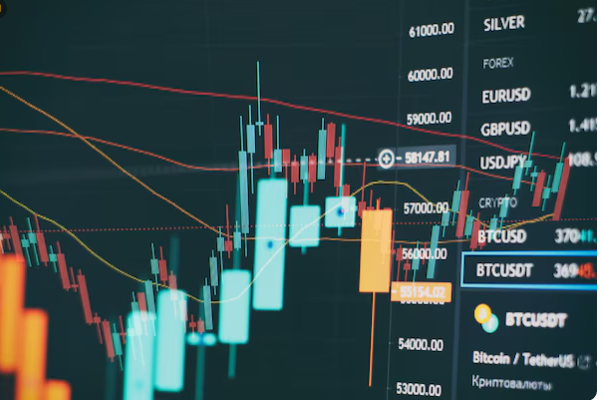

After a while, the screens on a normal trading desk—columns of figures, tiny arrows, flashes of green and red—tend to blend together. However, one ticker has been attracting attention lately: NVDA. The change isn’t as spectacular as meme stocks used to be, but there’s a consistent tug, as though investors are witnessing something bigger happening beneath the surface.
After a slower start to 2026, NVIDIA shares have recently been trading in the mid-$170 range. Although it’s hardly a breakout rally, the momentum seems to be rebounding. The stock’s 52-week range, which spans from around $86 to more than $212, provides a more comprehensive picture that includes both optimism and apprehension.
Key Information About NVDA (NVIDIA)
| Category | Details |
|---|---|
| Company Name | NVIDIA Corporation |
| Stock Ticker | NVDA |
| Founded | 1993 |
| Headquarters | Santa Clara, California, USA |
| CEO | Jensen (Jen-Hsun) Huang |
| Employees | ~42,000 |
| Market Cap | ~$4.2 Trillion |
| Current Price (approx.) | ~$175–$176 |
| 52-Week Range | $86.62 – $212.19 |
| P/E Ratio | ~35 |
| Official Website | https://www.nvidia.com |
The tone surrounding NVDA appears cautiously hopeful when one walks through discussions on institutional research calls or financial forums. Median targets are still set by analysts between $250 and $274; some even propose levels above $300. According to investors, the demand for AI infrastructure is still high enough to support those estimates. It’s another story entirely if those assumptions are completely priced in.
It’s simple to ignore the physical aspect of NVIDIA’s expansion. The company’s impact is linked to physical gear, including as semiconductors, servers, and data center racks, in contrast to strictly digital platforms. Rows of GPUs are being deployed in labs and warehouses all across the world, humming softly while models are trained. Because of its actual presence, the stock tells a different story based on infrastructure rather than merely software.
Improved market mood seems to be connected to the bounce itself. Early in the week, reports of diplomatic progress caused global markets to rise, and NVDA followed. However, the stock’s resiliency probably has deeper causes. After all, the need for rapid processing hasn’t decreased, even in times of instability. If anything, it has spread to sectors of the economy that previously felt cut off from AI.
NVIDIA’s stance is nearly counterintuitive in the tech community. It is susceptible as well as dominant. dominant since its GPUs are still essential to the advancement of AI. vulnerable due to ongoing competition, particularly from cloud providers creating in-house chips. How that equilibrium changes over the coming years is still unknown.
This conflict is reflected in the company’s valuation. A mid-30s price-to-earnings ratio indicates confidence but not unbridled enthusiasm. Despite their apparent willingness to pay more, investors are nevertheless keeping a careful eye on growth metrics. This equilibrium produces a stock that responds to signals rather than conjecture and moves slowly as opposed to explosively.
The larger cultural environment is another factor. Unlike many semiconductor businesses, NVIDIA has quietly become a household name. It is currently at the forefront of AI discussions, having previously been mostly linked to gaming GPUs. Observing this change gives the impression that the business has transitioned from a specialized technology supplier to a fundamental infrastructure provider.
Jensen Huang, CEO, contributes to that impression. His appearances, which frequently feature his trademark leather coats, combine ambition with technical expertise. Investors appear to react to the story he crafts about rapid computers as well as to earnings reports. Nevertheless, without consistent execution, leadership narratives can only go so far.
The current trading volume of almost 180 million shares indicates ongoing participation. This degree of activity suggests that both retail and institutional investors are still involved. Even in times when the market is slower, it’s difficult to ignore how frequently NVDA gets mentioned.
Inevitably, comparisons to former tech leaders come up. Some analysts argue that infrastructure suppliers frequently profit from long-term demand, comparing NVIDIA’s situation to that of early cloud computing firms. Others warn that expectations might already be too high. Depending on how rapidly AI adoption generates revenue, both viewpoints seem tenable.
The future of the stock could depend on supply, which is less obvious. Manufacturing limitations may become a limiting issue as demand for AI chips increases. The growth story gets stronger if manufacturing scales smoothly. Bottlenecks could cause sentiment to change rapidly.
The volatility of NVDA’s chart over the previous year, with its abrupt increases, corrections, and recoveries, tells its own tale. It avoids the unpredictable swings of speculative investments, but it also doesn’t move like a solid utility stock. Here, there is a compromise that exhibits both assurance and prudence.
Observing this event gives one the impression that NVDA is more than just a stock responding to market dynamics. It serves as a stand-in for confidence in AI. Optimism over technical advancement appears to follow share price increases. Doubts start to arise when they stall.
And maybe that’s why people continue to notice the ticker. not only for what it stands for now but also for what investors believe it may indicate in the future.
