
“Then I came across the memorial to ‘The 76’ in a village near my holiday home in France and the story suggested itself,” Michael says.
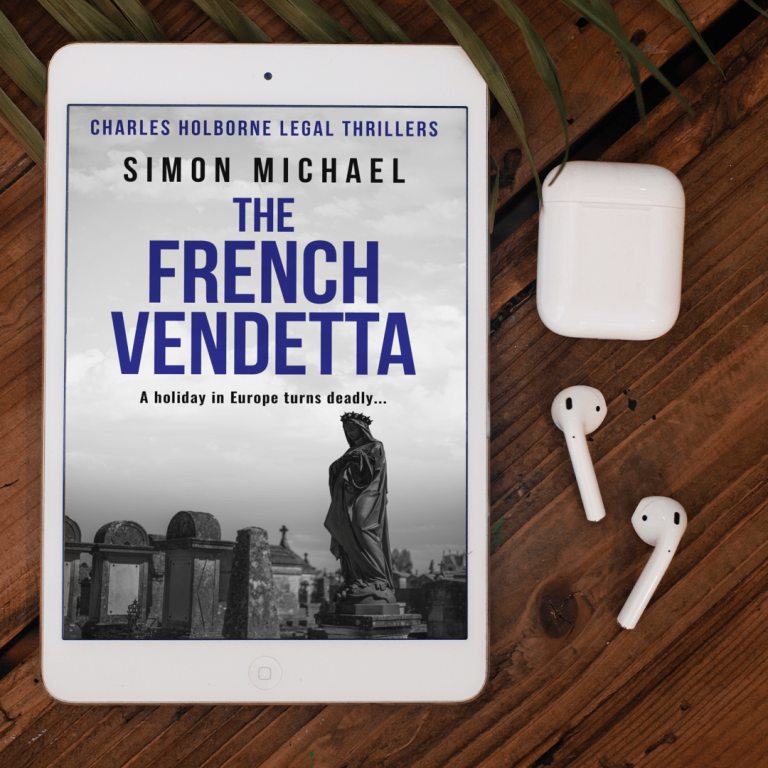
That discovery became The French Vendetta, the 11th instalment in Michael’s Charles Holborne legal thriller series, published on 15 May by Sapere Books. For the first time, the long-running series leaves the grimy London courts and gangland underworld behind, transplanting barrister Charles Holborne and his wife Sally into rural France—where a vendetta rooted in Nazi occupation still festers.
Michael isn’t your typical crime novelist. Before turning to fiction full-time, he spent 37 years at the criminal Bar, handling murder defences and later catastrophic clinical negligence cases involving life-altering injuries and deaths. That courtroom pedigree bleeds into every page.
The authenticity shows. Early readers have called The French Vendetta “gripping”, “authentic” and “the best book of the series so far.”
What hooked Michael wasn’t just the memorial itself, but the realisation that wartime wounds haven’t healed—even eight decades later. “I stumbled across a wonderful mystery in the heart of the Gascon countryside which I felt could be used as the background for another case,” he explains. “I discovered there is still ill-feeling in some French villages between families whose members fought in the Resistance and others who either supported or acquiesced in Vichy rule.”
The novel explores those fault lines: collaboration, resistance, silence, revenge. Themes that refuse to stay buried.
Michael’s Charles Holborne series has built a loyal following since its launch, precisely because it doesn’t feel like fiction written by someone who Googled “how do barristers work.” The protagonist—a brilliant, conflicted Jewish defence barrister—navigates murder trials, organised crime and institutional rot during the turbulent 1960s and early 1970s. Michael describes that era with blunt clarity: “At that time London was effectively the Wild West of British justice. The Metropolitan Police was deeply corrupt, and gangs like the Krays and the Richardsons dominated the criminal landscape.”
That period, with its moral chaos and power struggles, provides fertile ground. But Michael insists the books transcend their historical setting.
“The books are not simply crime novels,” he says. “They explore prejudice, abuse of power, corruption in institutions and the struggle of ordinary people against powerful organisations. Those themes remain just as relevant today.”
The legal thriller market is crowded with courtroom drama, yet few writers bring genuine trial experience to the page. Michael’s decades defending clients—often in cases where guilt and innocence blurred—give his work texture that purely imaginative fiction struggles to match. His characters operate in moral grey zones because that’s where real justice lives.
“Real life occurs in shades of grey,” he observes. “I’m interested in how ordinary people, often in difficult circumstances, struggle to find the right course between right and wrong.”
Eleven books into the series, Michael has made a deliberate choice that sets his work apart: his characters age. Charles Holborne isn’t frozen in time like so many fictional detectives and lawyers who solve case after case without gaining a wrinkle or a moment of doubt.
“I’ve never had much patience with characters who never grow older,” Michael admits. “Charles changes with the times. He gets older, wiser, his relationships evolve and the world around him changes too.”
That evolution mirrors Michael’s own journey. After nearly four decades in London courtrooms, he relocated to Cheshire, settling on the edge of the Peak District. The shift transformed his writing life.
“I absolutely love it here,” he says. “People are kinder, there’s space to think, and I find it easier to concentrate looking out over fields, trees and rivers.”
From that quieter vantage point, Michael has been able to push his series beyond British borders. The French Vendetta marks new territory—literally. But the core tensions remain: power, memory, justice, and what happens when old crimes refuse to stay buried.
The book is available now in paperback, eBook and audiobook formats.
Michael’s exploration of wartime collaboration and resistance speaks to questions that France—and much of Europe—still grapples with. Who gets to tell the story? Who gets to be remembered? And what happens to communities where neighbours still remember which families stood with the Resistance and which turned away?
The memorial to ‘The 76’ provided the spark. The novel that followed asks whether some vendettas ever truly end—or whether they simply wait, patient and poisonous, for the next generation to inherit them.
For Michael, who has spent a career watching people navigate impossible moral choices in courtrooms, the shift to exploring those choices in a French village makes sense. Geography changes. Human nature doesn’t.
Whether readers will follow Charles Holborne across the Channel with the same enthusiasm they’ve shown for his London cases remains to be seen. But the early response suggests Michael has tapped into something deeper than a change of scenery—he’s found fresh soil where old secrets still grow.