
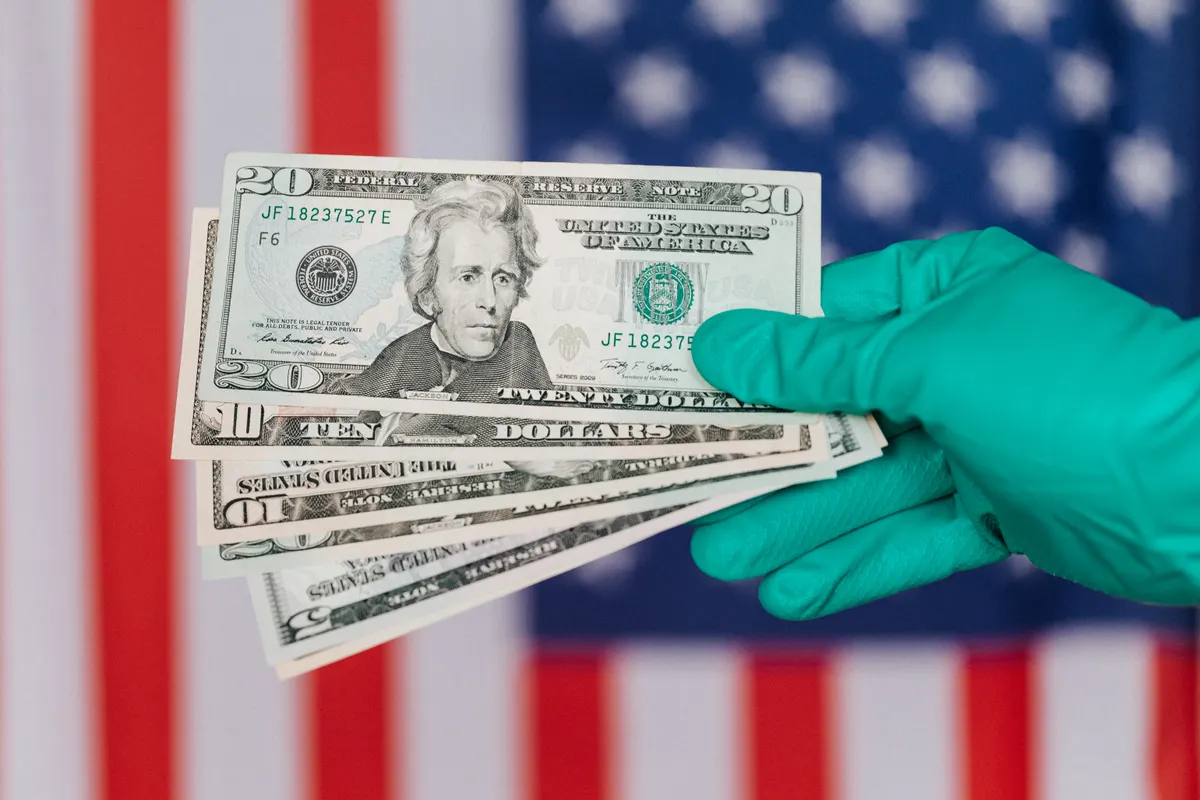

The Trump dividend proposal, announced on 9 September at the Republican Midterm Convention in Dallas, would hand every American adult a $5,000 cheque, but only if Republicans win control of the House and Senate in the upcoming midterm elections. ‘If the Republicans win, you win with us and you get $5,000,’ President Trump told the convention, branding it the ‘Trump Dividend.’
The plan drew immediate criticism from economists and fiscal watchdogs. The Committee for a Responsible Federal Budget (CRFB) estimated the total cost at $1.2 trillion, sufficient to more than double next year’s projected $780 billion primary deficit to $2 trillion, and push total projected deficits to $3.1 trillion in 2027. That would lift the deficit from a projected 5.8% of GDP this year to 9.4% in 2027.
With roughly 245 million American adults, according to CBS News, the arithmetic is straightforward: $5,000 multiplied across that population yields approximately $1.25 trillion, consistent with CRFB’s figure. Vice President J.D. Vance told Fox News the payment would be aimed at the middle class, though no means-testing mechanism has been specified. CRFB noted the cost could be somewhat lower if higher earners were excluded.
The Trump Dividend Proposal and the Tariff Funding Gap
Vance has pointed to tariff revenue as the funding source, arguing that ‘all of these tariffs … those penalties have generated a lot of revenue.’ The numbers do not support that claim. The CRFB’s press release states that new tariff revenue, generating less than $200 billion a year, is already factored into existing deficit projections and cannot be used as an offset for fresh spending.
The Tax Foundation puts the figure lower still. Its senior economist Erica York, writing on 10 September, estimated Trump’s new tariffs would net about $125 billion in 2027, concluding that ‘it would take almost a decade of collections from the tariffs to cover the cost,’ according to the Tax Foundation’s analysis. CRFB also found that Section 301 and Section 338 tariffs imposed under authorities unaffected by court rulings replace less than 60% of the revenue lost from tariffs struck down, further narrowing the available base.
Eric Boehm of Reason was blunt: ‘Revenue from tariffs, which are really just taxes on Americans, will not come close to covering this proposed expenditure.’ Competitive Enterprise Institute Senior Economist Ryan Young went further, telling Fox Business that the proposal ‘is not going to happen, even if Republicans win the midterms.’
To place the scale in context: CRFB calculates the dividend would cost more than all three COVID-era stimulus payments combined, more than the projected 2027 cost of the One Big Beautiful Bill Act, and is 50% larger than the entire primary deficit projected for 2027.
Argentina’s Warning: Fiscal Populism Before a Presidential Vote
Observers in Argentina recognised the approach immediately. In 2023, then economy minister and Peronist presidential candidate Sergio Massa launched what became known as the ‘Plan Platita’ (‘Little Money Plan’) roughly two months before the October presidential election. The package included one-time payments to workers, bonuses for retirees and the unemployed, tax exemptions, expanded food card benefits, and price caps on tens of thousands of products. Bloomberg reported at the time that the spending ramp-up was likely to fuel already-rising inflation.
Economists warned the plan was a short-sighted attempt to sustain buying power before the vote. They were correct. With no access to credit markets, the Kirchnerist government financed the measures by printing pesos, accelerating a currency collapse already well under way.
The economic backdrop when Milei took office tells its own story. According to the BTI 2026 Argentina Country Report, annual inflation stood at 211.4% (the highest in three decades) with a budget deficit of 6.1% of GDP, a poverty rate of 47.1%, and public debt at 155.4% of GDP. The Plan Platita did not save Massa politically. He finished first in the first round with approximately 37% of the vote but lost the runoff to Javier Milei after the centre-right’s Patricia Bullrich directed her supporters to Milei’s camp.
The Trump dividend proposal differs from Massa’s Plan Platita in one respect: it is explicitly conditional on an electoral outcome, making the political transaction more transparent. Massa distributed benefits before the vote regardless of result. Trump’s conditionality is, if anything, more brazen as a mobilisation device.
The United States economy is not Argentina’s in 2023. But the mechanism being proposed, deficit-financed transfers justified by revenue that does not exist, timed to an election, follows a pattern whose consequences Buenos Aires lived through at 211% annual inflation. CRFB projects the dividend would worsen inflation precisely because the funding gap cannot be closed by tariffs alone.
Trump said on 13 September that ‘the $5,000 is going to happen 100 percent.’ Whether Congress ultimately passes it is a separate question. The deficit arithmetic, however, does not change with the level of confidence expressed from the podium.
