
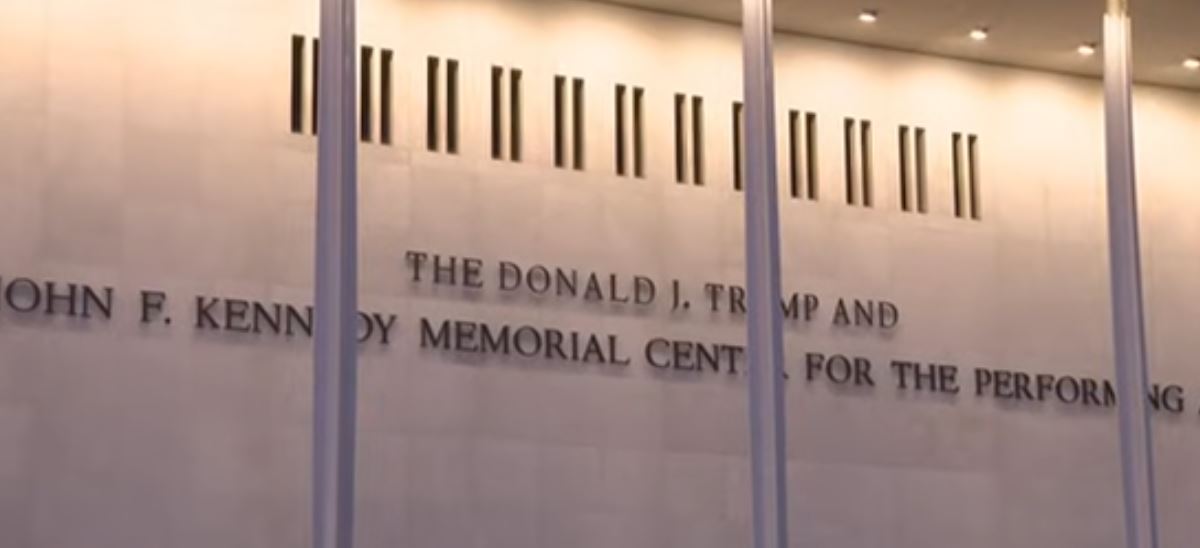

Overnight in late December, a well-known monument in Washington underwent a transformation. The name that had previously stood alone was subtly changed on the lettering outside the Kennedy Center to the Trump-Kennedy Center, which caused instant and obvious uproar.
This shift was the result of a short board meeting that was allegedly planned by recently appointed trustees who support Trump. Rep. Joyce Beatty, who called to protest, claimed that her microphone was muted. The website was rebranded and the signs were up in a day. That speed seemed deliberate, as though it would be more difficult to undo the faster it became true.
| Item | Details |
|---|---|
| Institution | The John F. Kennedy Center for the Performing Arts |
| Issue | Board vote to rename venue “Trump‑Kennedy Center” |
| Lawsuit Filed By | Rep. Joyce Beatty (Ohio Democrat, ex officio trustee) |
| Core Legal Argument | Only Congress can rename the Center, which was designated by statute as a memorial |
| Court | U.S. District Court for the District of Columbia |
| Status | Lawsuit pending; administration expected to respond |
| Related Controversy | Proposed two‑year closure for renovations; performer cancellations |
With the support of Democracy Defenders Action and the Washington Litigation Group, Beatty filed a lawsuit a few days later. Her argument is based on a specific and well-defined legal point: the Kennedy Center was established by statute of Congress. Thus, she contends, the only body with the constitutional power to rename it is Congress.
This battle feels more significant than a building’s signage for a reason.
For many years, the Kennedy Center has served as the capital’s cultural hub, a place where dancing, music, and the arts can take center stage while politics takes a backseat. It was created in 1971 as a living tribute to President John F. Kennedy. It was distinguished from other venues by that classification, which was enshrined in federal law. It was made for Kennedy, not just named after him.
A complicated challenge to that identity is currently taking place.
In a statement, the White House justified the move, calling the president’s accomplishments “restorative” and pointing to modernization and financial restructuring. They have presented it as a merited homage. Critics, such as the Kennedy family, however, perceive something different: a political overreach disguised in bronze letters.
“The Kennedy Center can no more be renamed than the Lincoln Memorial,” said Robert F. Kennedy’s grandson Joe Kennedy III on the internet. Despite being lyrical, his remark highlights a significant legal issue: may a board vote change a statutory name without legislative approval?
President Trump’s announcement on February 1st that the center would close for two years beginning July 4th, citing extensive renovations and a complete redesign, increased tension. The announcement was made in the face of growing criticism from performers, artists, and fans who had already started to boycott planned events.
This year’s performance by musician Chuck Redd, who is well-known for his yearly holiday jazz act at the center, was canceled. He called the renaming a betrayal of civic and cultural heritage. His absence signaled a cultural shift, not just a symbolic one.
Such a sudden rebranding bears emotional weight for an organization that is known for constancy. I once saw a student dance company perform on that stage. The performance was humble and sincere. The way the audience, which included families, visitors, and regular customers, stood up at the conclusion as though cheering something greater than the dancing, however, really got my attention. Not simply programs, but memory is stored there.
The need for renovations is genuine. An estimated $250 million was spent on hundreds of upgrades, according to a 2021 engineering assessment. Just a small portion of that work has received funding. However, many people believe that a two-year closure is the only viable option, which is unfair. particularly when connected to tighter board control, rebranding, and political reform.
This is about narrative, not just marble and lights. The best of American inventiveness was supposed to be housed at the Kennedy Center. What else is negotiable if its identity is changed without widespread agreement?
The problem is especially complex from the standpoint of governance. The Kennedy Center functions as a private nonprofit organization despite having a federal charter. Despite relying on public funds, it maintains managerial autonomy. It is susceptible to changes in political tides because of this structure.
Critics contend that the present board has consolidated power in a manner remarkably reminiscent of corporate takeovers by appointing loyalists and amending bylaws. Cultural institutions, particularly those based on national memory, shouldn’t operate that way.
In his lawsuit, Rep. Beatty requests that the court void the board’s decision, take down all digital branding and signs associated with Trump, and rename the facility. In-depth reports of procedural infractions, including her own exclusion from the meeting, are included in her brief.
Within a few weeks, the administration is anticipated to answer in court. The signals are still there, and the discussion is still going on.
The deeper discussion has already started, regardless of whether the courts concur with Beatty. Should any president, present or future, be able to use internal board wrangling to add their name on a federally recognized memorial? What safeguards the public’s faith in organizations that are supposed to be independent of politics?
Stronger legal frameworks to handle situations like these are probably going to be developed in the upcoming years. More precise limits will be needed to address the issue of institutional name, particularly for cultural assets. In the face of changing administrations, this might be especially helpful in protecting the nation’s legacy.
The Kennedy Center case might end up being the most educational of its kind, but it won’t be the last.
Two names are currently engraved above the building’s columns. A legacy-based one. The other is up for dispute. The court’s capacity to understand the boundaries of authority and the significance of memorials may determine whether one is kept, not politics.
