
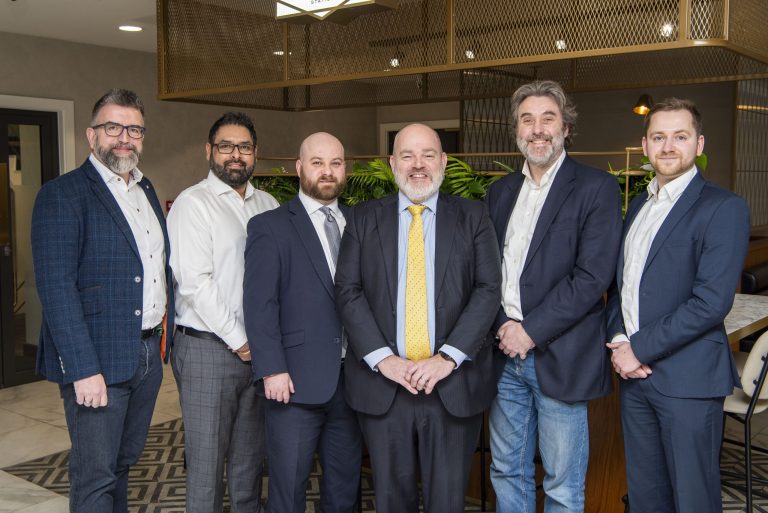
The appointment, announced in February, forms part of a six-strong recruitment and promotion drive that includes the firm’s first-ever IT director and a consultant brought in specifically to launch an intellectual property practice.
Peters arrives from Knights, where he built a reputation as a Legal 500 Leading Individual in Yorkshire and the Humber. His engineering background—he’s a qualified engineer who worked in aerospace before switching to law—gives him an edge in manufacturing disputes, a specialism the firm is keen to deepen.
Two other senior figures joined alongside him. Clive Lawrence takes on intellectual property work as a consultant, establishing a service line entirely new to Schofield Sweeney. And Craig Barraclough becomes the firm’s first IT director, overseeing everything from infrastructure to cybersecurity.
“I’m delighted to join Schofield Sweeney as an intellectual property lawyer,” Lawrence said. “The firm is well-known for combining a modern approach with traditional values. I’m looking forward to establishing intellectual property as a crucial service for the firm and working with clients across a range of industries.”
The IP expansion reflects a broader trend among regional firms seeking to compete with national players by adding specialist capabilities. For Schofield Sweeney—which operates from Bradford, Leeds and Huddersfield with a 175-strong team—the move into intellectual property represents a bet on client demand for more sophisticated commercial services.
Barraclough’s appointment as IT director signals something else: recognition that technology infrastructure now demands C-suite attention. His remit spans digital innovation and operational systems, responsibilities that would have sat with external consultants or junior staff at most firms even five years ago.
Meanwhile, three internal promotions accompanied the external hires. Jack Venable, who qualified at Schofield Sweeney in 2021, moves up to associate in the corporate team. Damian Kilroy becomes a partner in dispute resolution. Sandeep Singh takes on the role of associate IT manager.
Venable’s promotion came with a side note about his charitable work. Outside the office, he’s raised £42,000 for Dove House Hospice through Yorkshire’s Strictly Learn to Dance competition—a detail that says something about the firm’s culture, or at least what it wants that culture to represent.
“I’m looking forward to taking on greater responsibility in transactions, supervising junior colleagues, and upholding the standards that have been set at Schofield Sweeney – both in the quality of our work and the enthusiasm we bring to it,” Venable said.
For Peters, the challenge now is building a team capable of handling the kind of disputes that clients might otherwise take to Leeds or Manchester. His engineering credentials should help. Manufacturing disputes often hinge on technical details that lawyers without industry experience struggle to grasp.
That’s where his seven years in aerospace matter. Peters understands tolerances, supply chains, production processes—the practical realities that underpin contractual arguments when things go wrong between manufacturers and their customers or suppliers.
The firm has resolved both domestic and international disputes under his watch at previous roles, experience that Schofield Sweeney clearly hopes to replicate as it expands its manufacturing expertise.
Graham Sweeney, managing director, framed the appointments as evidence of ambition. “It’s fantastic to welcome our new senior recruits and see our current employees progress into new roles,” he said. “The new appointments and promotions demonstrate our commitment to providing excellent service for our clients who require expertise in complex fields. We are also proud to welcome our first IT Director to the business and look forward to seeing how technology will drive our organisational success.”
The timing, early in 2026, suggests the firm wants these hires bedded in before the financial year gains momentum. Regional legal markets remain competitive, with firms like Schofield Sweeney—recognised as a Times Best Law Firm and named one of the Sunday Times Best Places to Work in 2025—competing for talent against national outfits with deeper pockets.
Whether the IP practice gains traction depends largely on Lawrence’s ability to build a client base in a region where such services have traditionally been sourced from larger cities. Manufacturing clients need IP advice, particularly around patents and trade secrets. So do tech startups, a growing segment of Yorkshire’s economy.
The firm already handles planning, environmental law, contentious probate and real estate work, alongside niche specialisms in Islamic finance and energy projects. Adding IP broadens that offering, though it also adds pressure to cross-sell services across an increasingly diverse practice.
For now, the focus is on integration. Peters needs to recruit. Lawrence needs to prove demand for IP services exists at the level the firm anticipates. Barraclough needs to modernise systems without disrupting day-to-day work.
The promotions, at least, are straightforward. Venable, Kilroy and Singh already know the firm, its clients, its rhythms. They step up into roles they’ve been preparing for, even if the formal titles only arrived this month.
What remains unclear is how quickly the new hires will reshape the firm’s market position. Peters brings expertise and a track record. Lawrence brings an entirely new capability. Barraclough brings infrastructure thinking that could underpin everything else.
By year-end, the firm will know whether the investment paid off.